


Prime Minister Boris Johnson was making “very good progress” yesterday in his recovery in hospital from coronavirus, officials said, as the number of deaths in Britain from the disease approached the grim milestone of 10,000.
The coronavirus causes the Covid-19 respiratory disease.
The 55-year-old leader was spending his second full day out of intensive care at London’s St Thomas’s Hospital, where he has been able to take short walks between periods of rest, according to Downing Street.
“The prime minister continues to make very good progress,” a Downing Street spokeswoman said in a short statement.
He was hospitalised last Sunday over concerns that he still had a cough and high temperature after spending 10 days in self-isolation with the virus.
A day later he was transferred to the intensive care unit as his condition deteriorated.
Johnson left the unit on Thursday evening in “extremely good spirits” and waving at staff “in gratitude”, his spokesman has said.
His time in hospital was unprecedented for a British prime minister during a national emergency in modern times, rattling the country.
Britain continues to be hit hard, recording more than 900 daily Covid-19 deaths yesterday for the second consecutive day.
The health ministry announced in its update that another 917 coronavirus hospital patients had died in the latest 24-hour period, down on Friday’s toll but still the second highest yet.
It brings the total number of coronavirus fatalities in British hospitals to 9,875, while the number of confirmed cases in the country climbed by 5,234 to 78,991.
That figure is however thought to reflect only a fraction of the actual number of people infected, because not everyone has been tested for the virus.
Despite Johnson’s improving condition, it remains unclear when he might be discharged from hospital and how quickly he would return to work once out.
His spokesman stressed on Friday that his recovery was “at an early stage” and he would act only “on the advice of his medical team”.
The Sun tabloid reported that Johnson’s spirits had been lifted this week by his pregnant fiancée Carrie Symonds, who sent him daily “love letters” and scans of their unborn child.
Symonds, who has also suffered from coronavirus symptoms in recent weeks, and the British leader have reportedly not seen each other for nearly a month.
Their baby is due this summer.
Britain imposed a lockdown on March 23 in a bid to curb the spread of the coronavirus and ministers have been pleading with Britons to observe the ban on social gatherings over the Easter weekend when much of the country has been bathed in sunny, Spring weather.
“People have got to stay at home unless there is a very good reason not to,” health minister Matt Hancock said.
That message comes though as the government has come under increasing pressure to detail how long the strict curbs on movement would last, with the shutdown meaning many businesses are unable to operate.
Ministers have said Britain needed to pass the peak of the outbreak before changes could be made, and Hancock said although the number of hospital admissions had started to flatten out, there was not enough evidence yet to have confidence they were past the worst.
“Our judgement is we’re not there yet. We haven’t seen a flattening enough to be able to say that we’ve reached the peak,” he told BBC radio.
A decision on the lockdown will not be made until next week the government has said, and some scientists have suggested the peak might still be some time off.
Hancock said “nobody knows” when it would be.
“There are all sorts of suggestions. Their job is to make their best estimate and advise us and we have a whole load of different pieces of advice from different scientists,” he said.
The death rate is also expected to increase over the next few days, health officials have cautioned, but they say they are hopeful that the lockdown will mean that the overall number of deaths will be below 20,000.
Initially Johnson took a more modest response to the outbreak than other European leaders but changed tack when projections suggested a quarter of a million people could die in the United Kingdom.
The government has come under fire for its initial response and a lack of preparedness, and there was criticism yesterday from doctors and nurses who said they were having to treat patients without proper personal protective equipment (PPE) such as masks and gloves.
Among those to have died after testing positive for Covid-19 are 19 healthcare workers including 11 doctors.
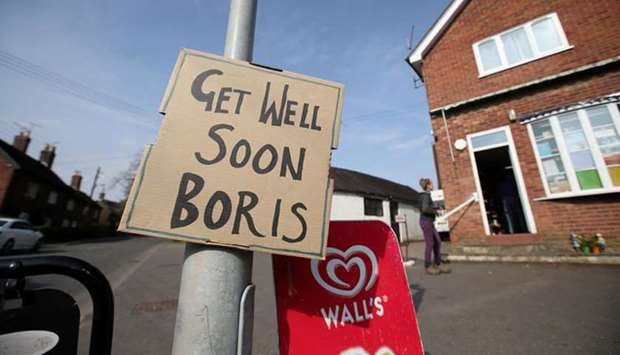
A sign of support for Prime Minister Johnson is seen in Swynnerton, England.