


Agencies/
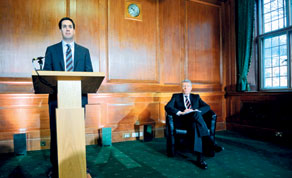
With his Shadow Chancellor Alan Johnson (right) seated on the sidelines, leader of the Opposition Labour Party Ed Miliband addresses a press conference in
Banks in

The day after Prime Minister David Cameron said that he wanted to see a smaller bonus pool than last year, his deputy, Liberal Democrat leader Nick Clegg, warned that sky-high pay-outs seemed to come “from a parallel universe.”
Their comments followed reports that Stephen Hester, the chief executive of bailed-out Royal Bank of Scotland (RBS), would be paid £6.8mn in bonuses and salary this year.
Opposition Labour leader Ed Miliband also weighed in yesterday, calling for the government to extend a one-year tax on bankers’ bonuses introduced by the previous Labour administration.
When Cameron’s Conservative-LibDem coalition came to power in May, ministers announced plans to replace the bonus tax with a broader bank levy, which is expected to raise £2.5bn a year from 2012-13.
Miliband claimed the levy would raise only £1.25bn this year and said this was insufficient at a time when sweeping austerity measures designed to pay down a huge budget deficit were beginning to bite.
He said that Labour’s bonus tax had raised £3.5bn last year.
“It is unfair and it is the wrong economic judgment to be cutting taxes for the banks at a time when everybody else is paying more,” he told a press conference in
“We believe the extension of the bonus tax for another year is not only fairer, but more responsible.”
However, Cameron’s spokesman said the bonus tax was specificially designed “as a temporary thing” because of the likelihood that banks would find a way to avoid it if it became permanent.
He noted that finance minister George Osborne said last year that “banks should be making their fair contribution but we don’t want to be driving them abroad and our aim would be to extract the maximum sustainable revenues from financial services”.
Speaking in a television interview Sunday, Cameron said he wanted bonuses to be smaller this year than last, particularly at RBS, which is majority owned by the taxpayer after a bailout during the financial crisis.
Deputy Prime Minister Nick Clegg said yesterday state-backed banks should show extra sensitivity and transparency on pay and bonuses, seeking to step up the pressure on an issue which provokes public anger.
The government has a stake of more than 80% in RBS and also owns a large minority of Lloyds Banking Group after rescuing both groups in the financial crisis.
Clegg said banks should show extra sensitivity to their shareholders, the British taxpayer, saying that they would have gone out of business without public support.
“All I’m saying, which I think it totally reasonable and most people in the country I think would agree with this, is that therefore, the people who run those banks should show extra sensitivity and transparency in the way in which they reward themselves,” Clegg told BBC radio.
“The directors of those banks have been asked to do a job, to fix those banks and make them healthy again, that job isn’t complete yet, and until it is, I think that should be reflected in the remuneration,” Clegg said.
The Liberal Democrats, the junior partner in the Conservative-led coalition, which took power in May, have been pushing for restraint on banker pay and bonuses.
Total bonuses are expected to fall this year due to lower profits at most investment banks, but about £7bn in bonuses is still expected to be paid out in the coming weeks, reigniting public anger at a time of sharp cuts in public spending.
On Sunday, Prime Minister David Cameron, said he wanted banks to award smaller bonuses, with RBS as a “backmarker”.
The Sunday Telegraph newspaper reported that RBS’ Chief Executive Stephen Hester would be awarded a bonus of £2.5mn. It also said he was to be paid an overall salary of almost £7mn this year.
More than 300,000 public sector jobs are set to disappear as the government’s public spending cuts begin to kick-in as it attempts to tackle a budget deficit of more than 10% of national output. Most government departments have to make savings of about 20%, at the same time Britons face rising costs and falling house prices.
RBS said no decision had been taken on Hester’s bonus, while a person familiar with the matter said any bonus was likely to be paid in shares, rather than cash, and could be deferred for several years.