


India’s stocks had their worst start to a fiscal year since 2007, a day after the benchmark equity index capped its worst quarter ever.
The S&P BSE Sensex Index slid 4.1% to close at 28,265.31 points, while the NSE Nifty 50 Index fell 4%. That’s the worst start to a fiscal year since a 4.7% drop for the Sensex on April 2, 2007. The gauge’s 29% plunge in the first quarter surpassed a record fall in 1992, as the nation dealt with a three-week lockdown and saw an acceleration of coronavirus cases.
In April, news flow around the potential peaking of Covid-19 cases will be key for foreign investors, while “domestic funds continue to use the correction to increase equities allocations,” S Hariharan, head of sales trading at Emkay Global Financial Services Ltd, wrote in a note. “Light positioning and thin volumes will lead to continued outsized moves in equity markets in both directions in the near term.”
Trading volume in India’s financial markets keeps thinning as thousands of traders and brokers work from home, and after banks curtailed operations during the second week of the lockdown. The Indian rupee weakened 1.3% in the forwards market to 77.19 per US dollar. Foreign-exchange and bond markets were shut for a bank holiday yesterday, while the stock market will close for a local holiday today.
India has confirmed 45 deaths and nearly 1,600 cases linked to the coronavirus, and experts fear the real tally could be much higher. Cases in the world’s second-most populous nation have ticked higher in the past week, raising alarm over the ability of India, with a fragile healthcare system and battered economy, to handle a virus crisis of the magnitude of China or Italy’s.
The government on Tuesday said it will sell Rs4.88tn ($64.5bn) of bonds in the six months to September, though auctions may get fewer bids as the crackdown to stop the spread of the virus forces traders and bankers to stay indoors. The central bank on Monday lifted restrictions on purchases of some government bonds by foreign investors.
India also plans to extend incentives worth $3.2bn for exporters to help companies hit hard by a demand slowdown globally due to the outbreak, according to people familiar with the matter.
The nation’s policy makers have rolled out a $22.6bn spending plan and delivered an emergency interest-rate cut to cushion the economy from the fallout of the lockdown. Foreign investors withdrew $7.9bn from Indian stocks last month through March 30, the biggest monthly outflow ever, according to Bloomberg-compiled data since 1999.
All 19 sector sub-indexes compiled by BSE Ltd declined, led by a gauge of bank shares. Kotak Mahindra Bank Ltd sank the most among Sensex companies and was its biggest drag.
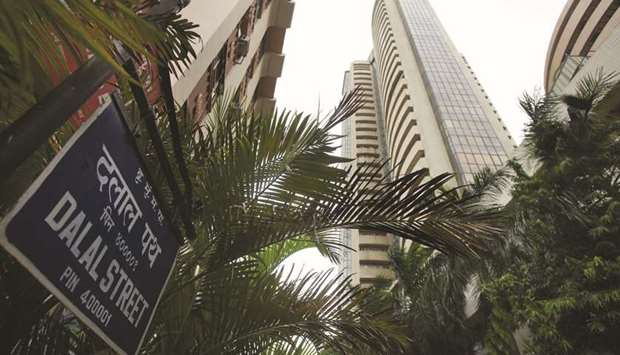
The Bombay Stock Exchange building in Mumbai. The Sensex slid 4.1% to close at 28,265.31 points, while the NSE Nifty 50 Index fell 4% yesterday.