


Italy’s daily Covid-19 disease death toll shot back up yesterday, but more evidence emerged that the coronavirus infection rate is slowing thanks to a painful national lockdown.
The novel coronavirus causes the Covid-19 disease.
Health officials across the ravaged Mediterranean country are poring over every new piece of data to see whether two weeks of bans and closures have made a dent in the crisis.
The harshest restrictions are theoretically due to expire this evening – although the government is all but certain to extend them in some form for weeks or even months.
Italy’s 743 new deaths broke two days of successive declines that had taken the number down to 601 on Monday.
It set a world record of 793 fatalities on Saturday.
However, the rate of officially registered new infections was just 8% – the same as Monday and the lowest level since Italy registered its first death on February 21.
It had been as high as 50% at the start of March.
“The measures we took two weeks ago are starting to have an effect,” civil protection service chief Angelo Borrelli told the daily La Repubblica before yesterday’s toll came out.
He said more data over the next few days will help show “if the growth curve is really flattening”.
Few scientists expect Italy’s numbers – if they really are dropping – to follow a steady downward line.
The slowing contagion rate is offering a ray of hope in the midst of a global crisis that is deepening in parts of Europe and the United States.
Scientists believe that countries such as Spain and France are following in Italy’s footsteps with a lag of a few weeks.
The numbers from the US are also similar to those of Italy’s from about 20 days ago.
Most other European nations and some US states have followed Italy’s example and imposed their own containment and social distancing measures designed to stop the spread.
The data that Borrelli has gathered from Italy’s 22 regions are of crucial interest to global policy makers and medical experts.
They are, however, extremely reluctant to draw any definitive conclusions from the two-day drop.
Italy’s daily deaths are still higher than those officially recorded in China at the peak of its crisis in Wuhan’s central Hubei province.
They are also higher than those seen anywhere else in the world.
Italian officials are using the downward trend in infections to double down on their insistence that people stay home at all times, no matter the personal discomfort or economic pain.
Most big global banks think Italy has already entered a deep economic recession that could be more severe than anything seen in decades.
The Lombardy region around Milan at the epicentre of the pandemic has begun imposing €5,000 ($5,400) fines on those venturing outdoors without a good reason.
Borrelli said that he is in support of the measures because it is “credible” to assume that the infection rate is as much as 10 times the reported number.
Italy is perplexed over how it managed to become the global epicentre of a pandemic that began on the other side of the world.
Without blaming anyone or any single factor, Borrelli said: “From the very start, people were behaving in a way that fuelled the national problem.”
But he did point to a Champions League match between Italy’s Atalanta and Spain’s Valencia’s football clubs in Milan’s San Siro stadium on February 19 as a particularly egregious mistake.
It was attended by 40,000 fans who celebrated the local team’s win deep into the night.
“We can now say, with hindsight, that it was potentially a detonator,” Borrelli said of the match.
In a related development, Italian authorities announced yesterday the seizure of nearly 2,000 respirators intended for patients receiving hospital treatment for the novel coronavirus in Greece.
Respirator exports have been banned in Italy since February 25.
Italian police and customs officials said that the 1,840 units comprised both the valve that pumps oxygen and the accompanying mask and various tubes.
They said the equipment came in sizes that fitted both adults and children.
It was seized from a truck that was about to set off on a ferry.
Greece has reported 15 Covid-19 fatalities and more than 600 infections.
Yesterday Spain’s armed forces asked the North Atlantic Treaty Organisation (Nato) for humanitarian assistance to fight the novel coronavirus as the national death toll touched 2,700 and infections soared towards 40,000.
With the pandemic spreading across the world, Spain has been one of the worst-hit countries, logging the third highest number of deaths after Italy and China, with the latest toll standing at 2,696 after another 514 people died over the past 24 hours.
Despite an unprecedented lockdown imposed on March 14, both deaths and infections have continued to mount, with the Spanish army called in to join efforts to curb its spread.
With authorities stepping up testing, the number of people diagnosed with Covid-19 rose by nearly 20% to 39,673, the health ministry said.
Health authorities said it would become clear whether the lockdown is having the desired effect.
“This is a very hard week because we’re in the first stages of overcoming the virus, a phase in which we are approaching the peak of the epidemic,” Health Minister Salvador Illa told a televised news conference.
Like many other countries, Spain has been struggling with a lack of medical supplies for testing, treatment and the protection of frontline workers.
In a statement, Nato said that Spain’s military had asked for “international assistance”, seeking medical supplies to help curb the spread of the virus both in the military and in the civilian population.
The request specified 450,000 respirators, 500,000 rapid testing kits, 500 ventilators and 1.5mn surgical masks.
With the numbers still spiralling, the government of Prime Minister Pedro Sanchez sought yesterday parliamentary approval to extend the state of emergency for an extra two weeks, until April 11 – the day before Easter – in a bid to slow the spread of the virus.
“We are aware of just how hard it is to prolong this situation, but it is absolutely imperative that we keep fighting the virus in order to win this battle,” government spokeswoman Maria Jesus Montero told the news conference.
Spain, she said, is in “the decisive phase in responding to the crisis, a crisis which was testing Spanish society in the most unimaginable way”.
“These are infinitely difficult days,” she acknowledged.
The surge in numbers has brought the medical system to the brink of collapse, with some 5,400 healthcare workers testing positive for the virus, or around 12% of the total.
The Madrid region has suffered the brunt of the epidemic with 12,352 infections – just under one-third of the total – and 1,535 deaths, or 57% of the national figure.
Speaking to TVE public television, the Madrid region’s top health official, Enrique Ruiz Escudero, said the crisis was “unprecedented in the history of Spain’s national health service”, suggesting that it is likely that the lockdown would extend beyond Easter.
“I think we are going to have to extend (the lockdown) until after Holy Week, that these (restrictive) measures will have to continue beyond that,” he said of the period running up to Easter which this year falls on April 12.
With the city’s funeral services overwhelmed, Madrid officials have commandeered the Palacio de Hielo ice skating rink to serve as a temporary morgue.
“We don’t have the logistical capacity to carry out all the burials and cremations at the rate at which people are dying,” Madrid’s Mayor Jose Luis Martinez-Almeida told TVE public television.
The Spanish capital has also transformed part of a giant exhibition centre into a field hospital with 1,500 beds which could be expanded take in up to 5,500 patients.
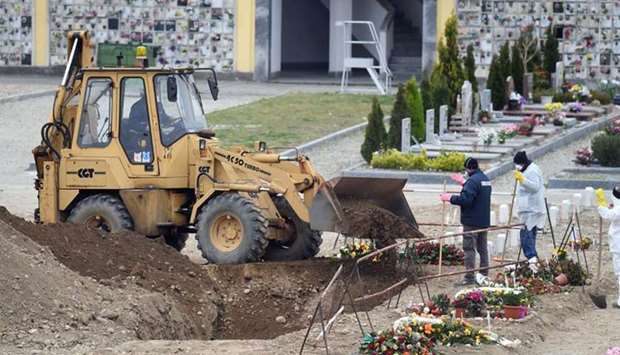
Workers use an excavator at a cemetery in Milan, as the spread of the coronavirus disease (Covid-19) continues.