


Panic over the spread of the coronavirus sparked a prison riot in Colombia that killed 23 inmates, as Chile became the latest Latin American country to announce restrictions on movement.
Rioting swept through the crowded jail overnight in the Colombian capital Bogota amid rising tensions over the virus in the penitentiary system.
Justice Minister Margarita Cabello described the violence as an attempted mass breakout, part of what she said was a co-ordinated plan with inmates who caused disturbances in 13 jails across the country.
The minister rejected accusations by rights groups that the riots were sparked by unsanitary conditions inside a prison system that was woefully unprepared to face the pandemic.
A curfew in Chile “will take effect throughout the national territory from 10pm to 0500am,” Health Minister Jaime Manalich announced.
The country, which has 632 infections, registered its first death from the pandemic at the weekend. Ecuador, which has seen the region’s second-greatest number of deaths after Brazil, marked its highest daily increase on Sunday, doubling to 14 dead and 789 positive cases.
Quito on Sunday ordered the military to take control of the worst-hit province of Guayas in the south-west of the country.
Government Minister Maria Paula Romo said the armed forces had been authorised “to manage the province of Guayas as a national security zone”.A nationwide curfew has been in place since Tuesday.
Governments in the region have been stepping up efforts to try to slow the spread of the pandemic, which has claimed 13,500 lives worldwide Argentina, Bolivia, El Salvador and Paraguay are among a growing number of countries to impose a total lockdown of their populations.
Colombia will join the group from midnight today with a 19-day mandatory lockdown of its 48mn population.
Bolivia’s government criticised sections of the population for ignoring its lockdown on Sunday.”We are not going to do this with a 98% lockdown. We are only going to defeat the coronavirus with 100% commitment,” Defence Minister Luis Fernando Lopez said.
Unlike other regional leaders, Brazil’s President Jair Bolsonaro has played down the crisis, though the pandemic has left 25 dead in his country, with 1,546 confirmed cases.
State governors have taken matters into their own hands, with Sao Paulo’s Joao Doria ordering a 15-day quarantine that requires a “total closure of non-essential businesses and services” and Rio’s governor closing the city’s iconic beaches.
On Sunday, Brazil’s development bank (BNDES) announced it would inject 55bn reals ($11bn) into the economy to counteract the impact of the coronavirus.
The funds will be used to protect more than 2mn jobs and to finance the suspension of interest payments and direct and indirect loans of Brazilian companies with BNDES for six months, as well as to increase the supply of credit for small and medium businesses.
Brazil agreed on Sunday with Uruguay to close their land border for the next 30 days, to prevent the spread of the virus. Only Brazilian citizens or residents, as well as Uruguayans with Brazilian spouses or children, may enter from the neighbouring country.
Freight transport may continue to cross the border.
Brazil’s top football clubs are handing over their stadiums to allow health authorities to turn them into field hospitals and clinics to fight the pandemic.
With football in the country suspended until further notice, more than half the clubs in Brazil’s Serie A have given up their stadiums, as authorities in densely populated Sao Paulo and Rio de Janeiro seek to expand hospital capacity to deal with the crisis.
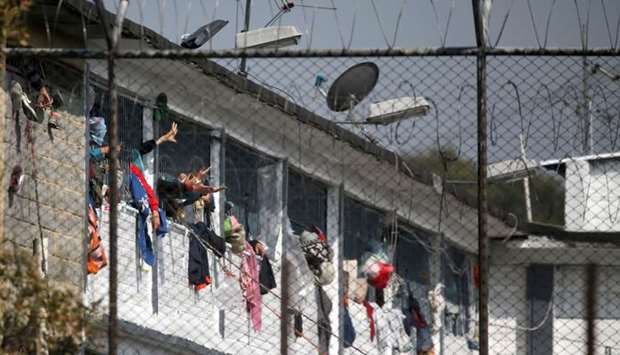
Inmates extend their hands through windows at the Modelo prison in Bogota after a riot.