


The government yesterday ordered schools to close for millions of children until further notice after criticism that the government was too slow to react to the spread of coronavirus.
The majority of schools will close from tomorrow, although some will be asked to remain open to support the children of essential workers like health care employees, Education Minister Gavin Williamson told parliament.
“I know the situation has become increasingly challenging. I said before that if the science and the advice changed such that keeping schools open would no longer be in the best interests of children and teachers that we would act,” said Williamson.
“We are now at that stage. The spike of the virus is increasing at a faster pace than anticipated.”
The shutting of so many schools will have massive economic and social repercussions for the world’s fifth-biggest economy.
It will alter the lives of almost 9mn British children and force parents to stay home from work to look after them.
The decision came after headteachers were increasingly forced to turn away pupils by either closing or partially closing schools because of staff shortages.
The move to shut schools is a reversal of the government’s recent cautious stance towards tackling the virus.
Britain had previously resisted pressure to follow Italy, France, and Spain by officially shutting schools. The government had said that school closures would not halt the outbreak and would deprive the country of key public sector workers.
Head-teachers had expressed frustration after schools had been advised to stay open when the government has stepped up advice earlier this week to curb social contact to try to slow the spread of the virus.
Earlier, Scotland announced it would close its schools from tomorrow and the government in Edinburgh said there was no guarantee they will reopen before the summer.
“We will of course only keep them closed for as long as we absolutely have to,” said Scotland’s First Minister Nicola Sturgeon. “But at this stage, I cannot promise that they will reopen before the summer holidays.”
Schools yesterday began writing to parents asking if they worked in sectors that will be required to carry on through the peak of the crisis such as medical professionals or care workers.
Meanwhile, supermarkets yesterday stepped up efforts to safeguard supplies, especially for vulnerable and elderly customers, as the sector battles stockpiling caused by coronavirus panic.
In an e-mail to customers, the head of Britain’s biggest retailer Tesco said that from today, it would have “a storewide restriction of only three items per customer on every product line”, adding that multi-buy promotions would be scrapped.
All the nation’s major supermarket chains have curbed the number of in-demand items - like toilet roll and antibacterial wipes - that people can buy.
Meanwhile, to keep shelves stocked with essential items, Tesco will close its meat, fish and deli counters, as well as salad bars, while no store will trade beyond 10pm said chief executive Dave Lewis.
Tesco will also allow its “more vulnerable and elderly customers” to have a priority one-hour slot in most stores across three mornings a week.
Lewis asked customers to be understanding of the difficult challenges faced by Tesco staff.
“If you do go in-store and want to say thank you, then I’m sure they’d appreciate it,” he said in the e-mail. Tesco rival Sainsbury’s earlier yesterday said it would open its doors to only elderly and vulnerable people for the first hour of trade on Thursday.
Iceland, which specialises in frozen food, announced on Monday that some of its stores were opening one hour earlier to enable older customers to purchase essentials.
And smaller supermarket chain Booths, based in northern England, has recommended that only vulnerable and elderly shoppers use its stores for the first few hours of each day.
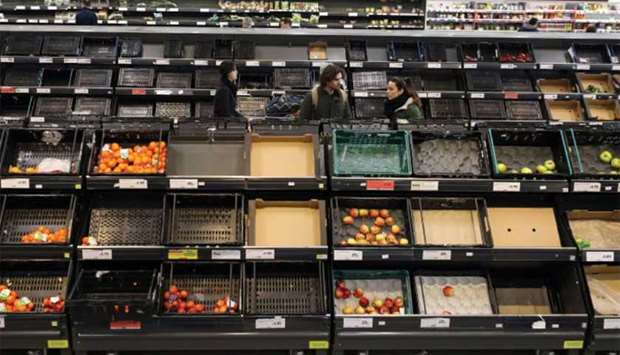
People walk past empty shelves at the fruit and vegetable aisle of a Sainsbury’s supermarket in Fulham, London, yesterday.