


“Weill Cornell Medicine - Qatar (WCM-Q) faculty, students and administrative staff have shown great agility and resourcefulness as we rapidly migrated teaching activities to online platforms”, dean Dr Javaid Sheikh has said.
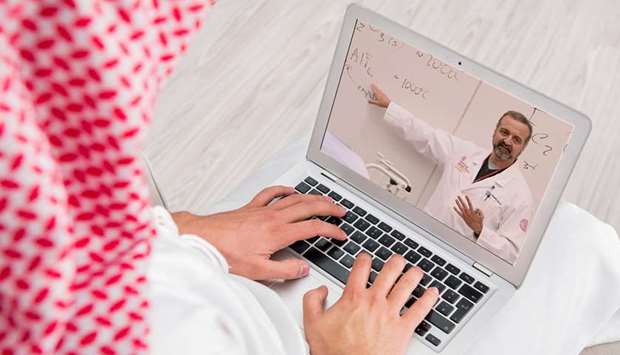
As the full implications of the global coronavirus pandemic became clear and public institutions began to close, the WCM-Q faculty, administrators and ITS specialists convened to start migrating the college’s pre-medical and medical curricula to online platforms.
“It was imperative that our transition to online teaching should take place quickly and as seamlessly as possible,” explained Dr Marco Ameduri, senior associate dean, Premedical Education and Education City Collaborative Curricular Affairs.
In making the leap to virtual classrooms, WCM-Q had a head-start, since it already delivers parts of its programmes via online platforms and is equipped with state-of-the-art audio-visual equipment and advanced computing capabilities. As standard practice, most lectures are recorded and made available via a third-party online video hosting platform, and students are in constant contact with faculty via phone, e-mail and video conferencing to ask questions about difficult material and receive feedback on their work. Since WCM-Q opened in 2002, the vast majority of its library has been online, with only a small physical collection kept at the college.
Dr Thurayya Arayssi, senior associate dean, Medical Education and Continuing Professional Development, said: “Like most colleges, WCM-Q has a well-established digital teaching strategy that has proved extremely effective and which is also very popular with students. They can pause, fast-forward and rewind every lecture and through our Distributed eLibrary they can access hundreds of thousands of medical texts, journals, databases, catalogues and other electronic resources. The early signs are that the students have adapted to the new circumstances extremely well.”
Nevertheless, there are certain parts of the curriculum that simply cannot be delivered online, such as anatomy classes and skills mastery sessions that take place in the WCM-Q Clinical Skills and Simulation Lab, which utilises hi-tech learning aids such as medical manikins and anatomically accurate models. To take account of this, the order in which the curriculum is delivered has been adjusted so that courses which require in-person instruction or access to physical learning resources can take place at a later date when the college reopens.
In addition to reorganising the curriculum, WCM-Q is also ensuring all students are aware of the support services available to them from the college’s student counsellors in the Division of Student Affairs.
“We are working hard to ensure that students who are concerned about their studies or need support with personal difficulties arising from the current situation or any other issue are able to access the services they need,” said Dr Ravinder Mamtani, vice-dean for Student Affairs-Admissions, Population Health, and Lifestyle Medicine.
Dean Dr Sheikh was of the view that teams across WCM-Q have demonstrated impressive flexibility to quickly set up new working arrangements.
u201cWe are working hard to ensure that students who are concerned about their studies or need support with personal difficulties arising from the current situation or any other issue are able to access the services they needu201d