


President Donald Trump has declared a US national emergency over the quickly spreading coronavirus, opening the door to more federal aid to combat a disease that has infected 138,000 people worldwide and left more than 5,000 dead.
The impact of the coronavirus on everyday life deepened around the world, and it was detected for the first time in several more countries.
More schools and businesses closed to try to slow its spread, governments took other drastic steps, the global sporting calendar was left in tatters and people faced greater restrictions on where they could go.
“To unleash the full power of the federal government to this effort today, I am officially declaring a national emergency – two very big words,” Trump said in remarks at the White House.
He said the action will open up access to up to $50bn in funds for states and localities in the fight against the coronavirus.
Trump also urged states to establish emergency operations centres.
He had faced criticism from some experts for being slow and ineffective in his response to the crisis and downplaying the threat.
Trump’s declaration of a national emergency, a seldom-used presidential power, enables the Federal Emergency Management Agency (FEMA) to assist state and local governments and co-ordinate the US response to the crisis.
The virus has killed 41 people in the United States.
The final global economic cost remains unknown, but travel bans have hammered airlines and travel companies, while financial markets have been hit by panic selling.
Despite a limited recovery yesterday, the main US stock indexes faced their biggest weekly declines since the 2008 financial crisis, and remain around 25% below the record highs achieved in mid-February.
The World Health Organisation (WHO) called Europe the epicentre of a coronavirus pandemic after the number of cases in China, where it originated, slowed to a trickle.
The WHO called the death toll reaching 5,000 globally “a tragic milestone”.
In Washington, the Democratic-led US House of Representatives is due to pass a coronavirus economic aid package, House Speaker Nancy Pelosi said, but it is unclear whether Trump or the Republicans would support it.
The package would provide for free coronavirus testing and two weeks of paid sick and family leave for those affected by the virus, Pelosi said.
The novel coronavirus outbreak has impacted social life throughout the United States with a flurry of closures announced, spanning Broadway in New York to Disneyland in California, as authorities promote social isolation.
Among the cancellations were the men’s and women’s collegiate basketball tournaments, which form an annual spectacle known as March Madness that sees over 600,000 attendees.
The professional basketball, hockey and baseball leagues have all been officially suspended, while entire school districts and museums have closed.
In California, Governor Gavin Newsom said all “non-essential” events of 250 or more people will not be permitted in the western state – home to more than 39mn people.
“Not holding that concert or community event can have cascading effects – saving dozens of lives and preserving critical healthcare resources that your family may need a month from now,” Newsom said in a statement on Thursday.
Disneyland said their iconic theme park in Anaheim, California will close today through the end of March “in the best interest of our guests and employees”.
The theme park has an estimated daily attendance of 50,000 people and was set to enter busy season as students start their annual spring vacations.
Schools shuttered in Ohio and Maryland and parts of Washington state, including the city of Seattle.
Northwestern Washington state is the hardest hit in the US, accounting for most of the 38 recorded deaths.
At least 19 states have declared a state of emergency over the virus, including the California and New York – the first and third largest economies in the US – with municipalities including New York City following suit.
“It’s math. It has to get worse,” said New York State Governor Andrew Cuomo at a press conference, where he also said he may have to cut elective surgeries to ensure hospitals are not overwhelmed.
In New York City – where thousands of people have entered self-quarantine over the virus – Broadway theatres and Metropolitan Museum of Art are closed.
He announced a ban on gatherings of 500 starting yesterday, but the shutdown of Broadway was effective immediately.
He said mass transit and hospitals were excluded, but noted that the subway system was already seeing dramatic declines in usage, as people stayed home.
Oregon, in the northwest of the country, announced a ban on gatherings of 250 or more people.
“It’s time for us all to do what we can to slow its spread and take care of one another,” Oregon Governor Kate Brown said in a statement, according to The Oregonian newspaper.
Restaurants in Seattle were closing, as it became clear hourly wage earners like waiters and bartenders were going to suffer earnings losses.
The Princess Cruises company announced a 60-day suspension of all its global cruise operations, cancelling thousands of planned vacations, in another signal of areas of the economy set to be battered.
Much of daily life has been affected, including weddings, school dances and music festivals, typically ushered in by spring.
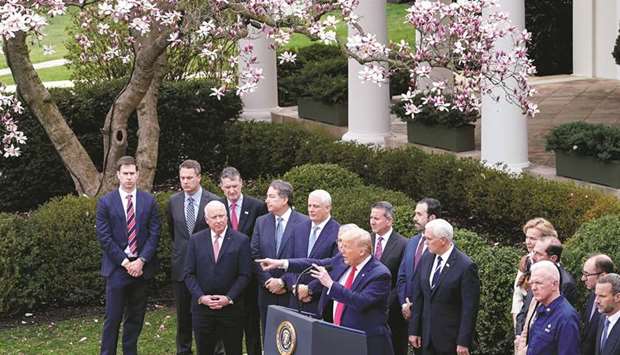
With members of the White House Coronavirus Task Force, Trump speaks at a press conference in the Rose Garden of the White House.