


A fifth person in the UK has died after contracting coronavirus, the health service said. “We can confirm that sadly, a patient in their seventies who was very unwell with a number of significant and long term health conditions has passed away at St Helier Hospital,” said Daniel Elkeles, chief executive for Epsom and St Helier University Hospitals NHS Trust in a statement.
“They had tested positive for Covid-19,” Elkeles said. “Our thoughts and condolences remain with the patient’s family and loved ones at this difficult time.”
“Here in the UK, as of this morning, there were 319 confirmed cases, very sadly this now includes five confirmed deaths,” Health Minister Matt Hancock said yesterday in a statement to parliament.
Meanwhile, the government has set up a specialist unit to combat the spread of disinformation about the novel coronavirus outbreak, officials said.
The culture department said teams had been brought together to provide a fuller picture of the potential extent, scope and impact of the issue.
“The aim is, where necessary, to identify and respond to disinformation related to Covid-19,” it added in a statement.
Prime Minister Boris Johnson yesterday chaired an emergency committee with scientific experts, with more stringent measures to delay the spread of the virus expected.
Culture Minister Oliver Dowden did not identify any specific source for the disinformation.
But he said preventing the deliberate or inadvertent spread of false information was a “top priority”, after several days of panic buying in supermarkets.
The government will have “regular engagement” with social media platforms to monitor and limit and its spread, he added.
Hancock added he was confident Britain’s food supply would not be interrupted by coronavirus even in the government’s reasonable worst-case scenario.
“We are confident that food supply will continue even in our reasonable worst-case scenario.
“We have been talking to the supermarkets for some time about this scenario,” he told parliament.
Earlier panic buying forced Britain’s biggest supermarket to ration tinned peas and other vegetables for online shoppers.
The restrictions at Tesco had previously only applied to cleaning products. Stores in some areas are so overwhelmed by online orders that they have no delivery slots for 11 days.
Most stores ran out of hand sanitisers – or imposed rationing on such items – a week ago, but the list of restricted goods has now grown to cover basic foods.
Rationed items listed on the Tesco website include most tinned vegetables, long-life UHT milk, dried pasta, hand sanitisers, anti-bacterial wipes and even bottled water.
It imposes a limit of five of each item per order. Some tinned products, such as green beans, have sold out online in certain regions.
Supermarkets are not thought to have the vehicles and drivers to cope with soaring demand from all those in home quarantine caused by coronavirus.
It has even been suggested that the army could be asked to provide extra drivers and vehicles.
Tesco’s strict rationing is likely to be followed by big rivals such as Asda, Sainsbury’s, Morrisons, Ocado and Waitrose. Shoppers are increasingly choosing to stay at home and order online after shelves at stores and supermarkets around the country were cleared of certain products.
A snapshot survey by the Daily Mail newspaper found most of these big firms did not have delivery slots to an address in London until Thursday. The earliest slot for one grocer was 11 days away, on March 19.
Thousands of shoppers descended on supermarkets over the weekend and cleared shelves of canned and packet foods, pasta, rice, toilet paper, soap, antibacterial wipes and disinfectant.
Customers reported that some outlets of Costco and Aldi were rationing the number of packs of toilet rolls customers could buy.
Responding to reports of people panic buying in supermarkets, Prime Minister Boris Johnson said: “We’ve had no advice from the scientific advisers or medical officers that there’s any need for people to buy stuff in.
“We will make sure we give the NHS the investment it needs to cope with this crisis.”
A government source said: “A couple of measures raised by retailers that could help alleviate any pressures were removing curfews for delivery vehicles, and government sharing data of areas where we have identified there may be hotspots of coronavirus so that they can ensure food stocks are moved accordingly.”
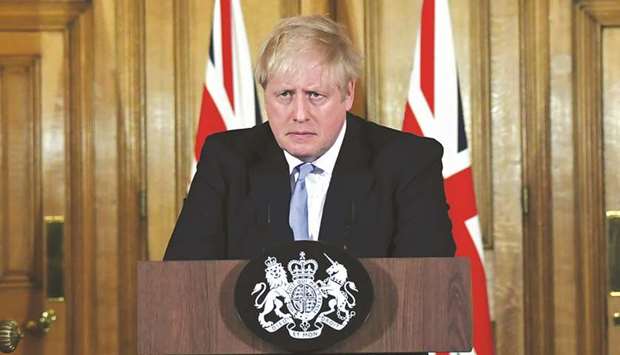
Prime Minister Boris Johnson attends a news conference on coronavirus at Downing Street in London, Britain, yesterday.