


Thousands of women rallied across the country yesterday, defying a backlash and warnings from right-wing groups who demanded that the “obscene” event be cancelled.
Rallies were organised in all major cities, where thousands of women, men and children marched carrying placards with slogans against sexual harassment, child marriage, and a lack of opportunities.
“Let’s smash the patriarchy and liberate female population from oppression,” rights activist Farzana Bari told a rally in the capital.
At one point in Islamabad, students from a religious institution hurled sticks and stones at women’s rights demonstrators, causing some injuries and forcing a crowd of people to seek cover before the police intervened.
Police official Mazhar Niazi said the officers blocked the Islamists as they tried to break through a cordon to attack the marchers.
A Reuters witness and Niazi said the Islamists pelted the marchers.
Niazi said no one was injured.
He said a criminal case would be registered against the Islamists for violating the law and attempting to attack the women’s march.
The march ended at a park alongside a separate “anti-feminist” Islamist rally, with the duelling protests separated only by a barrier and a line of police.
“The women in Pakistan are considered property by their male counterparts,” said Tahira Maryum, 55. “There is nothing vulgar in asking for your rights.”
At the Islamist counter-protest, dozens of women in burqas held their own placards including one saying “Anti-Feminist”, while shouting “Our bodies, Allah’s choice”.
AFP saw several men throwing sticks and stones at the women’s march.
Ismat Khan, a 33-year-old woman, said women’s rights activists were “naive” and being exploited by non-government groups and “the Jewish lobby”.
“We are free and to live our lives are according to Sharia,” she told AFP.
The Aurat March, or Women’s March, organised to celebrate International Women’s Day yesterday, has become the country’s largest rights activity, attracting tens of thousands of participants in the past two years.
Religious groups and right-wing political parties opposed the march because they believe women are entitled to the rights prescribed within the confines of Islam.
Opposition to the march intensified after last year’s event included slogans like “My body, my choice”, “My body is not your battleground”, and “Stop being menstrual-phobic”.
This year, anti-march campaigners filed unsuccessful court petitions to try to ban yesterday’s events, and a religious political party warned that it would stop the march at “all costs”.
A court in the eastern city of Lahore allowed the march there to take place on condition that organisers and participants adhered to “decency and moral values”.
The controversy escalated further this week when a TV and film writer used abusive language against a leading women’s rights activist who repeated one of the slogans during a live television debate.
The head of a religious political party later accused marchers of vulgarity and asked his workers to block it.
Another group organised a counter “modesty march”.
Marches in other parts of the country were held peacefully amid tight security.
In Lahore, a crowd of several hundred women and men took to the streets chanting slogans such as “Give me what’s mine” and “We want freedom”, while more than 1,000 people gathered in a park in Karachi, chanting slogans, beating drums and singing.
“We are not scared of mullahs (religious leaders), let them be jealous of us,” said Anis Haroon, a veteran women’s right activist in Karachi.
Pakistani social media was filled yesterday with comments both for and against the march with “HappyWomensDay2020” and “MeraHijabMeriMarzi” (MyHijabMyChoice) both in the top Twitter trends.
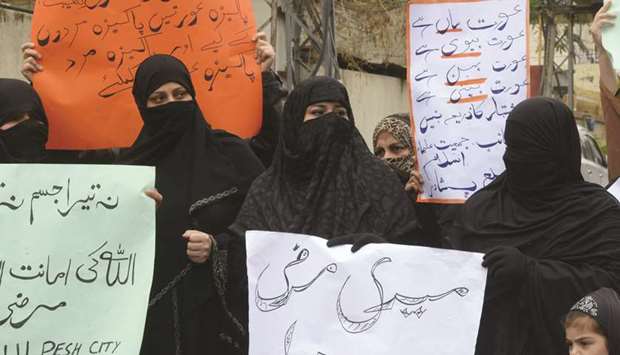
Women take part in rallies in Peshawar