


Italy yesterday closed all schools and universities until March 15 as the number of deaths from the new coronavirus in the Mediterranean country hit 107.
The measure is the most restrictive response to Covid-19 of any European nation and tougher than the closure of schools — but not universities — taken by fellow Group of Seven (G7) member Japan.
Meanwhile, Hungary yesterday reported its first confirmed cases — two Iranians studying in the EU member state.
“Two patients have been taken into medical care due to coronavirus infections,” Prime Minister Viktor Orban said in a Facebook video message.
“Two foreigners, students studying in Hungary, Iranians, they are currently symptom-free it seems, but confirmed as infected,” he said.
Italy yesterday reported 28 more deaths, the highest single day total to date.
The nation of 60mn people has now recorded over 3,000 cases and only trails China in terms of total fatalities.
Other measures discussed by top ministers and reported by Italian media include what promises to be an unpopular plan to play all football matches without fans for a month.
Italy has borne the brunt in Europe of a disease that is now spreading across the world faster than it is in the central Chinese region where it was first detected late last year.
The problem for the Italian government is that existing restrictions — including a quarantine of 11 towns with 50,000 people in the north — have failed to stop the outbreak.
The overwhelming majority of the fatalities have occurred in Milan’s Lombardy region and the neighbouring northern area around the cities of Bologna and Venice.
But 21 of the 22 regions have now had cases and infections are slowly reaching Italy’s less wealthy and developed south.
The government yesterday reported the first death south of Rome.
It came in the Puglia region that surrounds the city of Bari in the heel of the Italian boot on the map.
Top government minister spent hours huddling yesterday to chart a way out of a health crisis that threatens to tip Italy’s wheezing economy into recession and overwhelm hospitals.
Most of the steps being considered involve ways to avoid crowds and keep people from coming in contact with each other outdoors.
Media reports said people will be advised to stay at least 1m apart and to avoid crowded places whenever possible.
The traditional greetings of kissing on the cheeks or shaking hands are strongly discouraged.
Exhibits and shows are set to be rescheduled — a measure that will be especially painful for Italy’s already hard-hit hotel and restaurant industry.
Some of the government’s more mundane and common-sense measures include instructions to cough and sneeze in a handkerchief to avoid hands coming in contact with “respiratory secretions”.
Italians will also be urged to avoid sharing bottles and not to drink from the same cups and glasses.
The crowd-control measures will most directly affect football matches and could cause the most resentment in the sports-mad nation.
Italy’s Serie A has already been thrown into disarray by two weeks of postponements that have seen some clubs not play at all and others play multiple matches in a week.
Fans will even be prohibited from attending the training sessions of top teams such as Cristiano Ronaldo’s Juventus in Turin.
The government will also recommend to those over 75 to stay indoors and to avoid public places.
The advice extends to those who are at least 65 and suffer from other ailments.
A top civil protection official told AFP that most of those who have died in the past few days were in their 80s and 90s and were already suffering from other pathologies.
All these measures are meant to stay in place for a month and be reviewed and possibly fine-tuned after two weeks.
Dr Janos Szlavik at the Central Hospital of Southern Pest, Hungary, told reporters at a news conference that both patients had visited family in Iran recently and that their roommates were being taken into quarantine.
Authorities were making efforts to establish their travel history within Hungary and who they had been in contact with, Szlavik said.
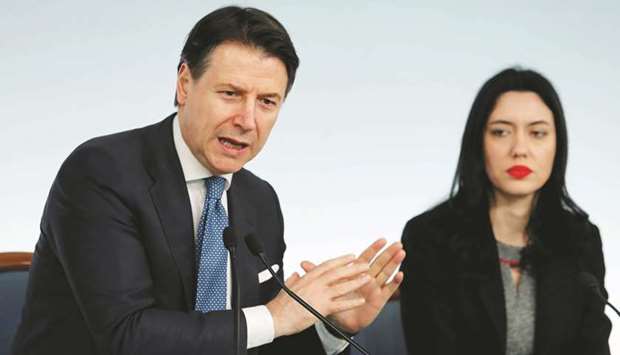
Italian Prime Minister Giuseppe Conte and Education Minister Lucia Azzolina address the media in Rome yesterday, announcing a decree that will close cinemas, schools in order to contain the spread of coronavirus.