


Three family members and a neighbour of a New York man infected with the new coronavirus have also tested positive, officials said yesterday, and the number of cases increased across the United States.
On Tuesday, officials said a man in his 50s who lives in a New York City suburb and works at a Manhattan law firm tested positive for the virus, the second identified case in the state.
The four new cases include three family members of the man, who is hospitalised, New York Mayor Bill De Blasio said in a statement. Health authorities said one of his children was a student at Yeshiva. The fourth was a neighbour of the infected family, bringing the total of confirmed cases in New York state to six.
The hospitalised patient had not travelled to countries hardest hit in the coronavirus outbreak, which began in China in December and is now present in nearly 80 countries and territories, killing more than 3,000 people.
The first New York case, reported last week, was in a woman who had returned from Iran, where at least 77 people have died.
Cuomo said about 300 students from New York’s college systems, SUNY and CUNY, were being recalled from five countries — China, Italy, Japan, Iran and South Korea — and would be flown on a chartered plane and then be quarantined for 14 days.
The latest data from the US Centers for Disease Control and Prevention (CDC) listed 129 confirmed and presumed cases in the United States from the previous 108.
The cases were 80 reported by public health authorities in 13 states plus 49 among people repatriated from abroad, according to the CDC website.
North Carolina became the 13th state to report a case on Tuesday.
Nine people have died in the Seattle area, health officials said.
Of the 27 cases documented as of Tuesday in Washington state in the Pacific Northwest, nine were connected to a long-term nursing-care facility in a Seattle suburb.
The area has the largest concentration of coronavirus cases detected to date in the United States.
“The people who we are most concerned about, who are most vulnerable are senior citizens, people with immune comprised situations,” Cuomo said.
“What we’re worried about: nursing home setting, senior care setting. That’s what we’ve seen in other places and that’s where the situation is most problematic.”
At least one school in the Bronx neighbourhood of New York City closed on Tuesday.
A synagogue in New Rochelle, New York, where the affected family lives and worships, has halted all services for the foreseeable future.
In Washington, US lawmakers were close to a deal on a multi-billion-dollar emergency bill to help fund efforts to contain the virus in the United States.
Negotiators in the US House of Representatives and Senate narrowed differences over the cost of potential vaccines, congressional aides said.
House Appropriations Committee chairwoman Nita Lowey, a Democrat, told Reuters that she expected the bill to total a little over $8bn.
Once the full House approves the bill, the Senate is expected to act quickly so that US President Donald Trump can sign the measure into law, putting funds into the pipeline to help stop or slow the spread of the virus.
New York’s Yeshiva University said one of its students had tested positive for Covid-19 — the respiratory disease caused by the virus — and it was cancelling all classes on Wednesday at one of its four New York City campuses as a “precautionary step.”
The US may invoke an emergency law to pay for uninsured patients who get infected with the new coronavirus, a senior health official said on Tuesday.
Public health experts have warned that the country’s 27.5mn people who lack health coverage may be reluctant to seek treatment, placing themselves at greater risk and fuelling the spread of the disease.
Robert Kadlec, a senior official with the Health and Human Services department told the Senate on Tuesday that talks were underway to declare a disaster under the Stafford Act, which would allow the patients’ costs to be met by the federal government.
Under this law, their healthcare providers would be reimbursed at 110% of the rate for Medicaid, a government insurance programme for people with low income, he added.
“We’re in conversations, initial conversations with CMS (Centers for Medicare & Medicaid Services) to understand if that could be utilised in that way and be really impactful,” Kadlec told a Senate committee.
President Donald Trump also touched on the issue as he headed to a briefing on the coronavirus outbreak at the National Institutes of Health in Washington on Tuesday.
“We’re looking at that whole situation. There are many people without insurance,” Trump told reporters.
Maia Majumder, an epidemiologist at Harvard, told AFP she was particularly concerned by low-wage workers in the service and hospitality sector, who cannot afford to take time off but could act as vectors to transmit the spread of the disease.
Canadian Prime Minister Justin Trudeau on Tuesday signalled his government’s readiness to help Canadian businesses weather the novel coronavirus epidemic, if necessary.
No specific measures were announced, however, while his office told AFP the potential impact is still being assessed and a response drawn up.
“We recognise the very real economic impacts of the coronavirus globally,” Trudeau told a televised news conference in Halifax.
“We are co-ordinating globally to try and make sure that there is a lesser impact on the global economy,” he said.
“We also recognise that there will be impacts on Canadian businesses, on Canadian entrepreneurs, and we will always look for ways to minimise that impact and perhaps give help where help is needed.”
Trudeau’s comments followed a conference call in which Canadian Finance Minister Bill Morneau and his counterparts from G7 leading industrialised nations agreed to use “all appropriate policy tools” to keep the virus epidemic from throttling economic growth.
Trudeau said the risk of the virus spreading in Canada was relatively low.
“I think the numbers so far bear it out,” he said. “But we of course will continue to monitor (the situation) very, very closely.”
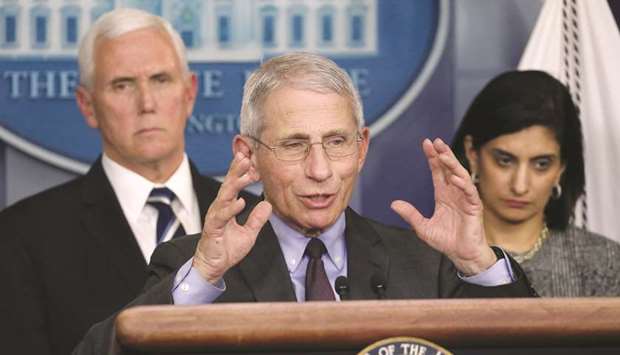
Vice President Mike Pence listens to Anthony Fauci, director of the NIH National Institute of Allergy and Infectious Diseases, as he answers a question from the media after Pence gave a news briefing about the coronavirus with members of the White House coronavirus task force at the White House in Washington on Tuesday.