


Mowasalat’s Karwa Driving School is partnering with Qatar University (QU) to conduct a study for ‘examining driving behaviour of adults with higher functioning autism spectrum disorders to develop and evaluate an innovative driving instructor training programme’.
Karwa Driving School will contribute to QU, which has been awarded this project by Qatar National Research Fund (QNRF).
Shafallah Center, Qatar, will provide support in helping with sampling and survey with students, faculty and attendants.
The study will focus on behaviour and intervention that improve quality of life and decrease risk -primary priority area and mobility and road safety.
The project is led by Dr Wael al-Hajyaseen from Qatar Transportation and Traffic Safety Centre (QTTSC) at QU in collaboration with University of Hasselt, Belgium.
The co-funding contribution management agreement has been signed between QU and the co-founder Karwa Driving School of Mowasalat.
QU will execute and produce comprehensive research studies on the topic.
The current project is aimed at comprehensively investigating driving behaviours as well as related psychological characteristics of novice drivers with Autism Spectrum Disorder (ASD).For this, self-report measures, cognitive tasks and a driving simulator will be used.
The to-be-developed simulated driving scenarios will serve as validated assessment tools in future research.
Furthermore, this project targets the development of innovative training modules for the driving instructors to equip them with the knowledge, tools and techniques to effectively develop driving capabilities and safe driving behaviours of novice drivers with ASD.
Information from this training will also be made available for free by developing an information folder, containing a summary of the training.
Fahad Saad al-Qahtani, CEO of Mowasalat, said that Mowasalat’s Karwa Driving School wishes to contribute funding for the research work for execution and implementation of the project.
“We are delighted to be part of this unique project for the first time in Qatar, to develop training modules with information to address people with ASD,” he said.
“We are happy partnering with QU, with which we have more than ten-year relationship partnering to promote driving vehicle safety through various campaigns, activities and initiatives addressing road traffic and driving safety. Through this project, Karwa Driving School will be developing and distributing the proposed training modules and information folder which we expect will encourage more people with ASD to obtain a driving license, enhancing their level of autonomy, confidence and lifestyle as they become less dependent on relatives and friends to assist in transportation requirements,” al-Qahtani explained.
Dr Khalid Naji, the dean of the College of Engineering at QU, said that the project comes with an economic impact.
“Firstly, if people with ASD become able to obtain a driver’s license, more will be able to pursue vocational goals. Secondly, the driving instructors will be able to attract more learners who experience difficulties with learning how to drive due to their ASD diagnosis. Thirdly, the utilisation of driving simulators in traffic safety and operation studies in Qatar is quite novel and will significantly enhance the understanding of driver behaviour in specific target groups such as people with ASD. Finally, this project will initiate active collaboration between research bodies and driving schools in order to improve driver-training programmes in Qatar,” he said.
Dr Naji added that those with ASD usually experience significant challenges in adulthood and successfully overcoming typical milestones.
“Those with ASD may lack to establish social support networks. A sense of failures can often impact one’s sense of self-esteem and can contribute to psychological effects that impair personal growth. They commonly wish to rely less on family support and to become more independent. The proposed investigation also focuses on training individuals with ASD to improve their presence on the road. Gaining further knowledge about the ASD population in Qatar which may help these individuals, their families, and to better understand the issues they face in order to ultimately improve their quality of life,” he said.
The proposed project builds upon and further extends recent international research on the relation between driving and ASD.
As little is known regarding ASD and driving in Qatar an initial problem assessment will be made.
This will be based on the existing literature, questionnaires, and simulated driving scenarios.
Information derived from the assessment will be used in the development of training modules for driver instructors.
Besides, driving simulation in a virtual environment can be modified to fit the research purposes.
This way, confounding factors can be controlled for and one can control the characteristics of the participants.
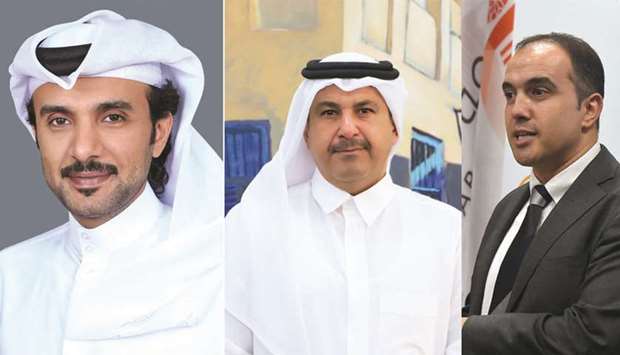
Fahad Saad al-Qahtani, Dr Khalid Naji, Dr Wael al-Hajyaseen