


The government of Pakistan appears trying to generate hopes about the future as it comes under criticism from all sides over the tough present economic conditions and public unrest.
The response, however, appears cosmetic and restricted to promises.
Amid rising inflation the highest in almost a decade led by the food sector, particularly wheat and sugar, the policy response has been too little too late.
The government enumerates a long list of measures to address the challenge and minimise the sufferings of the people but outcomes at the end of the day appear minimal.
The prime minister, meanwhile, is attributing these challenges to mafias and conspiracies to forestall the positive change he wants to bring to the country.
Opponents, on the other hand, point fingers towards his close circles for the profiteering and the mess.
In both cases, it boils down to a governance problem whether ‘mafia’ plays the havoc or ‘friends’ drive away with plunder – it proves an administrative failure.
Most of his public engagements in recent days and weeks have been events related to subsidies, charities and financial supports etc (Ehsas, Insaf Health, langarkhans, panahgahs) instead of relating to income generation, job creation or business activities.
The government officially said it was increasing the amount of stipends and number of its beneficiaries as policies and efforts to ease out inflation start bearing results in coming days.
No wonder then his government is marred by perceptions and recent surveys reinforce such perceptions.
The eye-opener has been the recent data collected by the government’s own Pakistan Bureau of Statistics.
The general inflation measured by consumer price indicator (CPI) increased by 14.6% in January over the same month of last year.
The details are rather alarming.
While the core CPI was recorded at 7.9% in January over January, the general CPI was up 14.6%, food inflation was up about 24% and prices of non-perishable food items were up 16%.
Startlingly, the perishable food items inflation was up a whopping 78.5%.
That indicates supply problems and could have been addressed by policy and administrative action – increasing supplies and attacking black marketing and hoarding. This is evident from higher prices of some selected common use items in January 2020 when compared with the same month last year.
These affect the poor the most.
A recent survey conducted by the Overseas Investors Chamber of Commerce and Industry (OICCI) suggested that foreign investors showed concerns with some areas of doing business and noted that a number of economic disciplinary measures announced by the government last year, like the partial withdrawal of incentives on new investments, also affected OICCI members.
When asked to name top five key pain points to their business, the chief executives of foreign companies identified, in order of priority, i) rupee devaluation, ii) gap between policies and their effective implementation, iii) increasing tax burden, iv) cost of doing business, and v) increase in borrowing cost/ interest rates.
They also noted that strong resistance, especially from a large segment of the market players in the informal economy, towards many bold measures to document the economy was having a negative impact on the business operation of international investors.
As these challenges persist just before the completion of the government’s second year in office amid a tight watch of the International Monetary Fund (IMF), the government is now trying to introduce a new mechanism that ensures stability to electricity tariff for a period of up to 18 months by working out a net average increase of about Rs1.20 per unit through a combination of monthly fuel adjustment, quarterly tariff adjustments and yearly revisions. Also, it is now contemplating working out a 3-year growth strategy (2021-2023) that should roll out with the coming budget and continue under implementation over the remaining period of the current government.
How it revives the consumer and business sentiment with high power-sector losses, revenue burden and expensive private credit would be interesting to watch. The IMF programme may need to be renegotiated in the process of improving political relations with Washington.
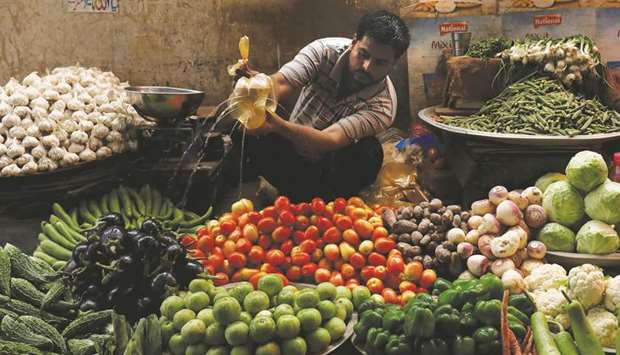
A vegetable seller sprinkles water to keep them fresh and shine at a makeshift stall along a market in Karachi. The general inflation in Pakistan measured by consumer price indicator increased by 14.6% in January over the same month of last year, according to a recent data collected by the government’s own Pakistan Bureau of Statistics.