


The turmoil engulfing global commodity markets deepened as China’s biggest buyer of liquefied natural gas told suppliers it won’t honour some contracts because of the coronavirus.
In a dramatic and rare step, China National Offshore Oil Corp declared what’s known as force majeure, meaning it won’t take delivery of some LNG cargoes, because the virus is constraining its ability to import the fuel. It’s among the first known cases of the legal clause being invoked in commodity contracts as a result of the epidemic.
While global markets bounce back from initial fears over the impact of the virus, CNOOC’s move shows the fallout is only deepening in the world of raw materials, which is dominated by China’s enormous appetite. Beijing’s efforts to contain the disease by shutting down swathes of the country and restricting travel are disrupting supply chains and hammering demand in the world’s biggest consumer.
The impact is reverberating around the world. Copper buyers are requesting Chilean miners postpone shipments because of port shutdowns while China’s biggest oil refiner, Sinopec Group, is likely to ask a Gulf supplier to reduce supplies of crude oil next month. Soybeans from Brazil and the US are being held up on arrival in eastern China and Indonesian palm oil shipments are also being delayed.
For LNG, CNOOC’s force majeure hurts a market already buffeted by rising US supplies and weak demand after a mild winter in Europe and Asia. Even before Chinese buyers walked away from supply contracts, spot prices have fallen to a record low, crippling the profitability of energy giants like Royal Dutch Shell Plc and Exxon Mobil Corp.
CNOOC sent the force majeure notice to suppliers including Shell and Total SA, according to people familiar with the matter, who asked not to be identified because the matter is confidential. Shell declined to comment while Total’s press office didn’t respond to a request for comment. The French company’s chief executive said he hadn’t received the force majeure notice.
China said last week that it would offer support to companies seeking to declare force majeure on international contracts. The clause allows a company to opt out of obligations without legal recourse because of reasons beyond its control.
CNOOC isn’t the only Chinese LNG buyer affected. The country’s largest oil and gas firm, PetroChina Co, was forced to delay discharge timings for multiple cargoes because it can’t get enough workers to its Rudong, Dalian and Caofeidian LNG terminals to run them at full capacity. The company hasn’t invoked force majeure because of the delays.
Virus has US gas exporters facing risk of output cuts
A grim situation for US natural gas exporters has gotten even worse as the coronavirus outbreak sends global prices falling on concern that China’s demand for the fuel will collapse.
Suppliers of American liquefied natural gas were already under pressure from depressed prices arising from a global glut and an unusually mild domestic winter. Now, with the virus threatening to disrupt industrial production across China, Asian spot LNG prices have hit a record low.
Faced with prospect of being unable to even cover their shipping costs, customers such as commodity trading houses may simply refuse to load US cargoes. Those cancellations could force LNG export terminal operators to cap, or “shut in,” production of the fuel as their storage tanks fill up.
“Forward prices for summer are now at levels where US LNG shut-ins begin to seem viable,” said Edmund Siau, a Singapore-based analyst with energy consultant FGE. “There is usually a lead time before a cargo can be cancelled, and we expect actual supply curtailments to start happening in summer.”
Such an outcome would be a blow to the young and fast-expanding US LNG industry. New export terminals from Maryland to Texas have sprung up to make the country one of the world’s top suppliers, while also providing a crucial outlet for soaring production from shale basins.
China hasn’t directly imported LNG from the US in a year amid trade tensions and tariffs on the fuel. But it’s the world’s fastest-growing buyer, and a slowdown or decline in demand there will have an effect that ripples right across the market.
Brimming global gas stockpiles are increasing the risk that cargoes will be curtailed, according to Nina Fahy, head of North American natural gas for Energy Aspects Ltd, and Madeline Jowdy, senior director of global gas and LNG for S&P Global Platts.
“The full impact of the coronavirus on global gas markets is yet to be felt as lower LNG demand expectations for the Lunar New Year were already built into most forecasts,” Jowdy wrote in an e-mail. “The global LNG outlook is going from bad to worse for suppliers.”
For Cheniere Energy Inc, the biggest US exporter of the fuel, “the summer doesn’t look good” for the economics of American cargoes at the moment, Eric Bensaude, managing director of the company’s marketing arm in London, said in an interview.
Any decisions by Cheniere’s buyers, which include Royal Dutch Shell Plc and Korea Gas Corp, are likely in March or April. That’s a period of seasonally lower demand when the company anticipates “people will be assessing the situation,” Bensaude said.
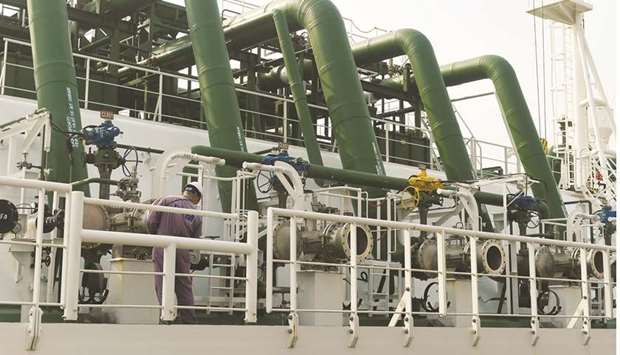
A worker inspects a valve on a liquefied natural gas (LNG) tanker at a port of the China National Offshore Oil Co (CNOOC) in Tianjin, China (file). While global markets bounce back from initial fears over the impact of the virus, CNOOC’s force majeure move shows the fallout is only deepening in the world of raw materials, which is dominated by China’s enormous appetite.