


Black-clad mourners packed Iran’s second city Mashhad yesterday as the remains of top general Qasem Soleimani were paraded through the streets after he was killed in a US strike.
“Iran’s wearing black, revenge, revenge,” they chanted as darkness fell and they followed a truck carrying Soleimani’s coffin towards the floodlit Imam Reza shrine.
The mourners threw scarves onto the roof of the truck so that they could be blessed by the “blood of the martyr”. Soleimani, who spearheaded Iran’s Middle East operations as commander of the Revolutionary Guards’ Quds Force, was killed in a US drone strike Friday near Baghdad airport.
He was 62.
The attack was ordered by President Donald Trump, who said the Quds commander had been planning an “imminent” attack on US diplomats and forces in Iraq.
Soleimani’s remains had been returned before dawn to the southwestern city of Ahvaz, where the air resonated with chants and shouts of “Death to America” during a procession.
People held aloft portraits of Soleimani, one of the country’s most popular public figures who is seen as a hero of the 1980-88 Iran-Iraq war.
The “million-man” turnout in Mashhad, northeastern Iran, forced the cancellation of a night ceremony in Tehran, said the Islamic Revolutionary Guard Corps who urged citizens instead to attend a memorial today at Tehran University.
Soleimani’s assassination ratcheted up tensions between Tehran and Washington and sparked fears of a new Middle East war.
Iran’s supreme leader Ayatollah Ali Khamenei vowed “severe revenge” and declared three days of mourning.
Late Saturday Trump warned that America would target 52 sites “important to Iran & Iranian culture” and hit them “very fast and very hard” if American personnel or assets were attacked.
Iranian Foreign Minister Mohamed Javad Zarif tweeted that “targeting cultural sites is a war crime”. Iran’s army chief said Trump’s threat was an attempt to distract the world from Soleimani’s “unjustifiable” assassination.
“I doubt they have the courage to initiate” a conflict, said Major General Abdolrahim Mousavi.
Iran’s communications minister, Mohamed Javad Jahromi, branded Trump in controversial terms in a Twitter post.
Khamenei’s military adviser, Brigadier General Hossein Dehghan, told CNN that Iran’s response to the assassination “for sure will be military and against military sites”. US Secretary of State Mike Pompeo admitted there was a “real likelihood” of an Iranian attack on US soldiers, warning however “it would be a big mistake”.
In Lebanon, Hassan Nasrallah, the head of the Hezbollah movement, insisted the “price” for Soleimani’s killing would be attacks on “US military bases, US warships, each and every officer and soldier in the region”. US-Iran tensions escalated in 2018 when Trump unilaterally withdrew from a landmark accord that gave Tehran relief from sanctions in return for curbs on its nuclear programme.
A year on, Iran began hitting back by reducing its nuclear commitments with a series of steps every 60 days, the most recent deadline passing on Saturday.
In Tehran, deputies chanted “Death to America” for a few minutes during a regular session of parliament.
“Trump, this is the voice of the Iranian nation, listen,” said speaker Ali Larijani.
Soleimani’s remains and those of five other Iranians — all Guards members — killed in the US drone strike had arrived at Ahvaz airport before dawn, semi-official news agency ISNA said. With them were the remains of Abu Mahdi al-Muhandis, the deputy commander of Iraq’s powerful Hashed al-Shaabi paramilitary umbrella group, who was also killed in the strike.
Soleimani’s remains are due to be flown to the capital, where Khamenei is expected to pray over them at Tehran University today before a procession to Azadi Square.
They will then be taken to the holy city of Qom for a ceremony at Masumeh shrine, ahead of a funeral tomorrow in his hometown Kerman. In neighbouring Iraq, pro-Iran factions ramped up pressure on US installations with missiles and warnings to Iraq’s troops late Saturday.
In the first hints of a possible retaliatory response, two mortar rounds struck Saturday near the US embassy in Baghdad, security sources said.
Almost simultaneously, two rockets slammed into the Al-Balad airbase where American troops are deployed.
Iraq said there were no casualties. The US military also said no coalition troops were hurt.
In another possible act of retaliation, hackers claiming to be from Iran breached the website of a little-known US government agency and threatened more cyber attacks.
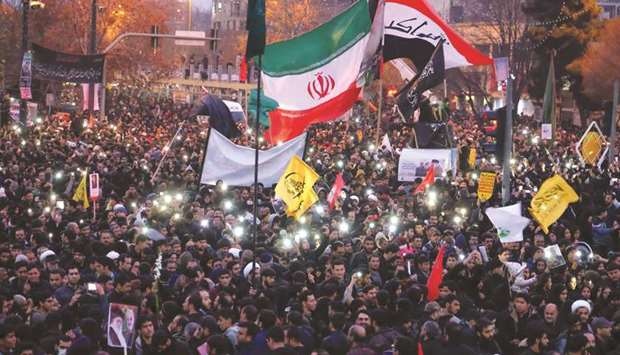
Iranians gather in the northeastern city of Mashhad yesterday to pay homage to top general Qasem Soleimani after he was killed in a US strike in Baghdad.