


BAE Systems Plc will win US Army approval this month for full-rate production of self-propelled howitzers and ammunition carriers based on improvements in the $10bn programme after several years of delays over welding defects.
“BAE has met all requirements to enter into full-rate production and we anticipate that happening” during January, Sam Tricomo, a spokesman for the weapon’s Army programme office, said in an e-mail.
The company had been assembling the weapons system since October 2013 under a series of low-rate production contracts during which it produced the vehicles late and with numerous welding defects.
Deliveries were halted for six months in 2017 because of welding flaws that required the return for repairs of 50 of 86 vehicles already delivered. Since then, London-based BAE has invested $200mn in improvements at its factory in York, Pennsylvania, and delivered quality vehicles consistently in the last months of 2019, according to the Army.
“To ensure no break in vehicle production” at the York facility and another in Elgin, Oklahoma, the Army last month extended low-rate production, Tricomo said. “Our confidence in BAE’s ability to deliver has increased month after month as we have seen continuous improvement in quality vehicles at increased production rates.”
Full-rate production is the most lucrative phase for a contractor. In 2018, the Army increased planned quantities of the howitzer and carriers by 109 vehicles to 689. The Army plans to spend $8.9bn on vehicle procurement for the Paladin Integrated Management programme, or PIM, that consists of the howitzer, which can fire rounds that travel more than 31 miles (50km), and the ammunition carrier that accompanies it.
About $3.9bn has been appropriated to date.
The 155mm Paladin howitzer and the ammunition carrier are the centrepiece of the Army’s artillery plans as it shifts its focus to countering Russia after 18 years of emphasising the defeat of terrorists. It’s part of the service’s “Long-Range Precision Fires” capability, which tops its list of modernisation priorities.
The weapon is scheduled to be upgraded in the next few years with a new Extended Range Cannon designed to match Russian systems in Europe.
BAE’s factory quality is a priority for the Army because it wants to increase production through 2023, not only for the howitzer system but also the other major military vehicles that BAE builds: the ArmoredMulti-Purpose Vehicle, the Bradley Fighting Vehicle and the M88A2 tank recovery vehicle.
The Army plans to surge production of the Armored Multi-Purpose Vehicle for deployment to Europe as part of the US’s deterrence buildup against Russia.
Defence Secretary Mark Esper was secretary of the Army when he signalled his concern by visiting the York facility in September 2018 to examine the welding process and deficiencies and hear solutions. The programme has a strong advocate in Senate Armed Services Chairman Jim Inhofe, an Oklahoma Republican.
“We are consistently delivering against the agreed-upon schedule,” BAE spokeswoman Alicia Gray said in an email. “This platform brings tremendous capability” and “goes a long way toward addressing the Army’s artillery modernisation priority. BAE Systems stands ready for the Army’s green light on full-rate production.”
As recently as April, programme officials had been privately pessimistic about BAE’s production capability in their annual Selected Acquisition Report for Pentagon officials and congressional committees marked “For Official Use Only.”
“At this time the Army does not have confidence when BAE will be able to deliver a quality product repeatedly,” according to the document.
The “Army chief of staff does not recommend certifying the PIM programme until BAE demonstrated the ability to produce quality vehicles on schedule.”
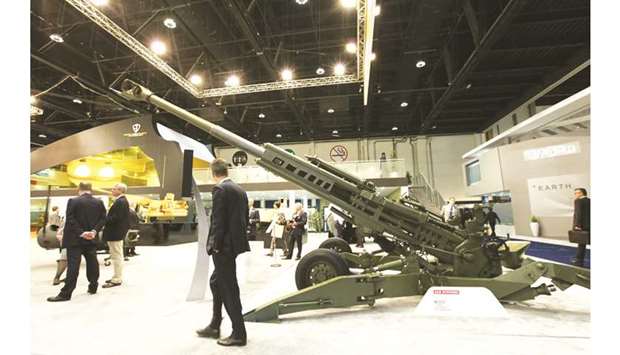
An M777 155mm lightweight field howitzer manufactured by BAE Systems stands on display at a defence exhibition in Abu Dhabi (file). u201cBAE has met all requirements to enter into full-rate production and we anticipate that happeningu201d during January, Sam Tricomo, a spokesman for the weapon’s US Army programme office, said in an e-mail.