


Singapore managed to avoid a recession in 2019, but the economy is growing “less vigorously than we would like” as tensions between its two largest trading partners seem likely to continue, Prime Minister Lee Hsien Loong said yesterday in his New Year’s message to the nation.
The upcoming budget will support businesses to raise productivity and build new capabilities, according to Lee.
The government will also help mid-career workers retrain and find new jobs, while the country’s social-safety net will be bolstered to protect the poor, elderly and vulnerable, the prime minister said.
The trade-reliant city-state hit a rough patch in mid-2019 amid the US-China trade dispute and a global economic slowdown.
The Monetary Authority of Singapore has forecast a modest improvement in 2020, with service sectors remaining healthy and demand potentially helped by a nascent recovery in the critical electronics industry.
Singaporeans “are worried about the state of the world, and we also have our own domestic concerns.
But we must resist the temptation to turn inwards,” Lee said in the speech. “A Singapore turned inwards cannot survive.” Recent economic data show persistent malaise in Singapore’s manufacturing sector.
Industrial production slumped 9.3% in November, its slowest year-on-year pace in almost four years, though markets have largely shrugged off the data.
The recent trade deal between the US and China has “partially relieved tensions, but it will not resolve the fundamental differences” between the two countries, Lee said.
Lee, 67, highlighted disillusionment in various parts of the world like Hong Kong, Chile and France – driven partly by economic inequality – saying that a loss of faith in the system was fuelling nativism and sectarian strife.
In Singapore, the government is tackling issues in education, housing, healthcare and transportation with measures including subsidies, new facilities and greater rail connectivity, Lee said.
His speech echoed themes voiced earlier in the day by Deputy Prime Minister Heng Swee Keat in an address posted on the ruling People’s Action Party website.
Heng, who is also the finance minister, said the government is looking at measures to tackle the economic slowdown. In October, Lee said Singapore would be “lucky” to achieve positive growth in 2019, adding that the figure would be “well under 1%.” That would mark a sharp slowdown from 2018, when gross domestic product grew 3.1%, according to Singapore’s Department of Statistics.
The Ministry of Trade and Industry is set to release more detailed GDP figures tomorrow for the fourth quarter and full year. The economy is expected to expand 0.5%-2.5% in 2020, compared with 0.5%-1% growth seen in 2019, the ministry said in November. Speculation is building that elections will be held after the government unveils its budget, expected to be in February.
Polls must be held by early 2021, and Lee previously has signalled that he intends to hand over power by the time he turns 70 in 2022.
“Everywhere globalisation seems to be in retreat,” Lee said. “We are in a better position than most countries, because for decades we have toiled to improve our people’s lives. And we continue to make steady progress, year after year.”
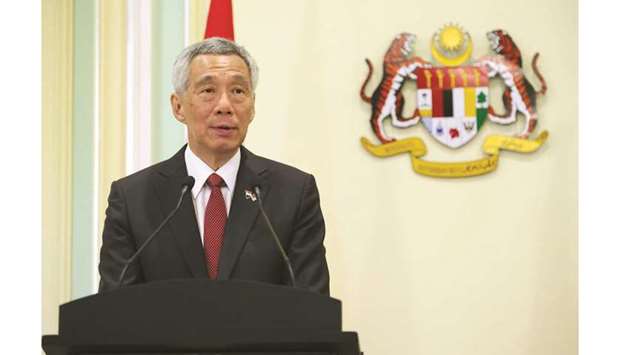
Lee Hsien Loong, Singapore’s Prime Minister, speaks during a news conference in Putrajaya, Malaysia. The upcoming Singapore budget will support businesses to raise productivity and build new capabilities. The government will also help mid-career workers retrain and find new jobs, while the country’s social-safety net will be bolstered to protect the poor, elderly and vulnerable, Lee said.