


Five years ago, Russian central bank governor Elvira Nabiullina’s decision to let the rouble trade freely faced a gut-wrenching test. An oil-price collapse and international sanctions had put the currency into a nosedive that even a 650 basis-point rate hike couldn’t immediately halt. Fast-forward half a decade and the picture in Russian markets couldn’t look more different.
The government’s decision to abandon currency interventions, a cautious interest-rate policy, and tighter budget rules, means it enters 2020 with more than half a trillion dollars of reserves and one of the world’s most lucrative carry-trade currencies.
And the rouble is set to top the pack again in 2020, offering a safe haven amid concerns over the trade war between the US and China, according to a Bloomberg survey of 57 global investors, strategists and traders.
Analysts at HSBC Holdings Plc see the currency gaining as much as 7% from current levels, calling it a “beacon of light” in emerging Europe, the Middle East and Africa.
The following points show how far Russia has come in the past five years: A high interest-rate differential relative to US borrowing costs and rouble strength have combined to yield the best carry-trade returns in emerging markets.
In fact, investors profited from rouble assets more than twice as much as the second-best performer, the Egyptian pound, which was floated in 2016. The Bank of Russia started cutting within weeks of its emergency hike at the end of 2014, which, for a while, led to negative real rates in the rouble.
However, falling inflation has restored those adjusted returns, which are almost as good as when the benchmark rate was at 17%. A budget rule that absorbs Russia’s windfall oil revenue has boosted international reserves as a percentage of the nation’s gross domestic product back to the highest level since 2010.
The government enjoys a twin surplus on its budget and current accounts, with both measures at the highest levels in at least a decade.
Plunging oil prices and international sanctions over Ukraine pushed the rouble to a record low in January 2016. Since then the budget rule has made the rouble less vulnerable to the oil price. The price of hedging against a potential default by Moscow using credit-default swaps has narrowed faster than a similar drop for the developing world.
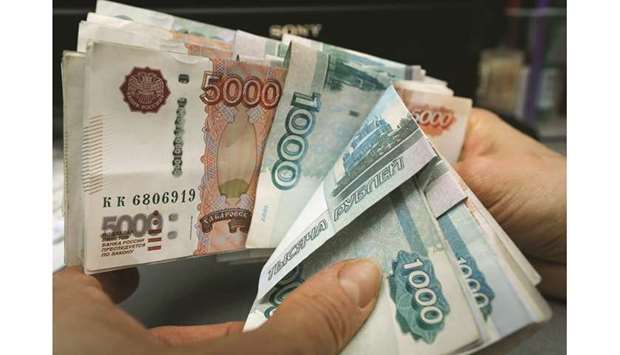
The rouble is offering a safe haven in 2020 amid concerns over the trade war between the US and China, according to a Bloomberg survey of 57 global investors, strategists and traders