


Plastic-free flights have grabbed the headlines and public attention in recent months.
In 2017, global production of plastic was estimated at 348mn tonnes.
According to estimates by the International Air Transport Association, airlines generated around 6.1mn tonnes of cabin waste in 2018, of which at least 20% was food and drink that had gone unused.
Plastic wrappings on an aircraft are very common these days. Plastic’s high functionality and relative cheapness make it the ideal material for a wide range of products and it has become ubiquitous in our daily lives.
Many items we readily discard are made from plastics, which are only intended for single-use.
Obviously, air travel generates millions of tonnes of waste every year. And that’s a huge environmental problem too.
But nearly 75% of inflight waste is recyclable, argues the nonprofit Green America, citing previous statistics from the Natural Resources Defense Council.
The good news is some airlines are seriously trying to tackle plastic pollution.
Regulatory oversight may have prompted the industry to act swiftly.
Many countries including those in the EU are pursuing continent-wide ban on single-use plastic.
This, coupled with public pressure over plastic pollution, has spurred airlines to make more ambitious commitments than they might have otherwise.
Although airlines are committed to reducing single-use plastics (SUP), the issue is not as clear cut as might first appear.
Getting rid of SUPs must show a demonstrable environmental benefit with alternatives also meeting safety and hygiene standards, IATA says.
Wooden stirrers instead of plastic ones are an easy win. But such instances are rare. Most of the numerous inflight products that use plastic present a real dilemma.
Paper cups, for example, have an internal plastic coating to stop the liquid leaking from the cup. This makes recycling and composting challenging, if not impossible, in most regions.
An obvious alternative is glass. But, obviously glass weighs a lot more than plastic or paper and the heavier the aircraft, the greater the fuel burn, and the higher the emissions. This dynamic can be seen in cargo too, where tarpaulin — the alternative to a plastic shrink-wrapped pallet — is far heavier.
In other words, some SUPs can be easily replaced, but others are far more challenging. SUP bags are used to collect washroom, galley and cleaning waste, for example, and alternatives need to be robust and waterproof to ensure there are no leaks onto the cabin floor.
And should there be viable alternatives, international waste regulations often insist that cabin wastes need to be landfilled or incinerated anyway, negating any positive environmental effect.
Meanwhile, ICAO’s guidance on Security Tamper Evident Bags (STEB) for duty free purchases states that the bags should be made from transparent low-density polyethylene (LDPE) or equivalent, but it’s not clear if there are any equivalents currently available.
“Simplifying and coordinating regulations will be essential if airlines’ ability to respond to these challenges is to improve,” a recent analysis by IATA has shown.
There has been a surge in SUP legislation with some 127 countries imposing restrictions on non-biodegradable SUPs — such as the thickness of the plastic — but few are aligned in any way, experts say.
So, plastics that are permissible on the outbound flight may not necessarily be allowed on an inbound segment or vice versa!
Moreover, some 27 countries have banned SUP products, including plates, cups, straws, and such materials as polystyrene. The expectation is that the number of countries imposing bans will double in a short space of time. In some instances, it is hard to know whether the SUP ban includes international or domestic flights and arriving as well as departing flights. It is also unclear if STEBs are affected and even plastics carried by passengers or packed in their baggage.
And even if airlines can find paper or biodegradable solutions, there must be appropriate facilities to recycle paper and support composting at airports.
“It is vital that governments consult with the sector to ensure that their regulatory proposals promote alternatives to SUP that are sustainable, safe, and hygienic and are harmonised across international aviation,” says Jon Godson, IATA’s assistant director (Aviation Environment).
Airlines are, meanwhile, exploring a number of innovative solutions of their own to reduce cabin waste. IATA’s forthcoming ‘Cabin Waste’ handbook actually lists 27 separate initiatives.
Suppliers are also being pressurised to find new processes and products that will reduce the industry’s overall environmental footprint.
To help airlines solve the dilemma of SUPs, IATA is studying the possibility of a sectoral approach to the lifecycle assessment of inflight products so airlines can base their service offerings on the overall environmental benefit.
It will also provide guidance on the application of harmonised smarter single-use plastic legislation for discussion with regulators.
Ultimately, “though seeking sustainable alternatives to SUP, the industry should prioritise efforts to reduce cabin waste in the first place, starting with the 20% of inflight food and drink that is untouched and ends up being landfilled or incinerated,” Godson says.
This could have a knock-on effect on efforts to raise awareness of the responsible approach to aviation’s environmental impact. “A visible lack of cabin waste reuse could impact passengers’ confidence in our ability to reduce our invisible emissions,” Godson noted.
IATA director general and CEO, Alexandre de Juniac, said, “While we all recognise that cabin waste and single-use plastics have become a big issue for us, replacing these items is not always as easy as it might appear, and we should be aware that there is always the possibility of causing unintended environmental damage. However, efforts to go green can also be hindered by regulation, and we must ensure we seek a smart regulatory approach to sustainability.
Truly, awareness around the issues associated with single-use plastics and their impact on the environment is increasing globally.
n Pratap John is Business Editor
at Gulf Times.
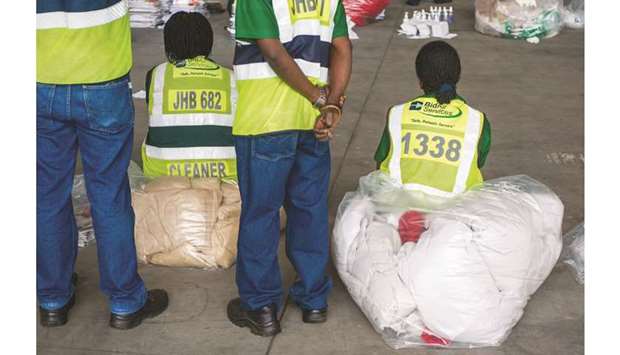
Cleaners sit on bags after removing catering items from an aircraft at O.R. Tambo International airport in Johannesburg (file). Getting rid of single-use plastics must show a demonstrable environmental benefit with alternatives, also meeting safety and hygiene standards, IATA says.