


A much-feared economic recession failed to materialise in 2019, but there was no shortage of financial trouble for companies. The amount of corporate debt trading at distressed levels hit a new cycle high in November, according to Bloomberg Intelligence.
That $127bn – the most since August of 2016 – reflects a year of idiosyncratic blowups sparked by issues ranging from the opioid crisis in the US to the growing influence of collateralised loan obligations and climate change.
“Distressed funds are putting out fires everywhere,” said Jason Dillow, chief executive officer of Bardin Hill Investment Partners, which manages about $9.4bn. “Heading into 2020 will be challenging for traditional distressed assets owned by managers now, but it will be a great opportunity for those who sit it out and buy after the drop.”
Bloomberg recaps the biggest blowups of the year that may have put a dent in bonuses and looks at what investors can expect for distressed debt in 2020.
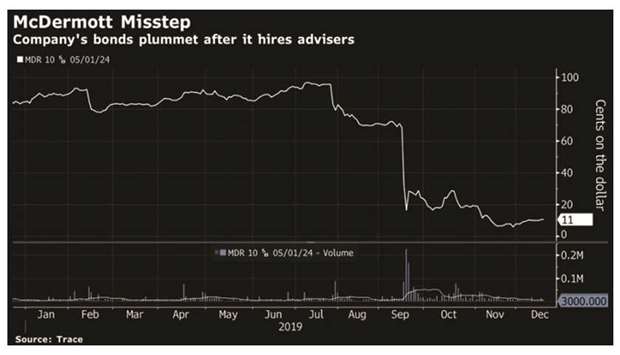
McDermott International debt load: About $5bn, according to Bloomberg Intelligence. The damage: Its 2024 bonds plunged to as low as 6 cents on the dollar, from nearly 97 cents in July. The engineering and construction firm’s stock and bonds collapsed in September as news that it had hired turnaround advisers surprised investors.
McDermott, which provides services to energy companies, has secured a bridge loan while it tries to sell its Lummus Technology business. Lenders gave it additional capital in December, and some creditors agreed not to force payment on the interest they’re owed, but that break runs out on January 15.
Bondholders have seen about 97% of their value evaporate as bankruptcy remains a clear and present risk. “A more meaningful restructuring of McDermott’s liabilities, and potentially certain projects, is necessary to position the company for longer-term viability beyond just addressing its unsecured notes, in our view,” Joel Levington, a Bloomberg Intelligence credit analyst, said in a note.
Frontier Communications Corp. Debt load: $17.5bn. The damage: The company’s bonds have dropped across the board, with its 8.5% notes due 2020 plunging from nearly 100 cents on the dollar to as low as 50 cents. With no meaningful debt maturities until 2022 and positive cash flow, the distressed telecommunications company was frequently thought of as a melting iceberg.
But creditors in Frontier, which provides land-line service in rural areas, started pushing for the company to address its debt load. After months of public and private pressure, Frontier started negotiations, replaced its CEO and is said to be considering a restructuring in the first quarter. “If you’re stressed for a number of years, or you’re operating with a stressed balance sheet, you just have to hit a bump in the road that sends you to court,” said Christian Hoffmann of Thornburg Investment Management Inc, which oversees about $45bn in assets.
Intelsat SA. Debt load: $14bn. The damage: Some of the company’s bonds hit their lowest level in more than a year, and are trading at levels that suggests bondholders may not be paid back in full. One of the hottest hedge-fund trades of the past year came crashing down in November when it emerged that the struggling satellite company’s plan to cut debt with proceeds from a proposed spectrum auction may not go as hoped.
Investors had widely expected that the Federal Communications Commission would let Intelsat and its partners holding so-called “C-band” spectrum sell it through a private auction, which would net more proceeds for cutting Intelsat’s $14bn of debt. Instead, the FCC said it would run a public process, and investors have to wait until 2020 to get clarity on what happens next. “With the control of the auction now in the hands of the federal government, the market is (rightly) questioning the extent to which Intelsat will be able to right-size its balance sheet and manage maturities in 2021,” CreditSights analysts David Shnaps and Jay Mayers wrote in a note.
“Intelsat remains a constructive participant in the complex C-Band proceeding,” Dianne VanBeber, a representative for Intelsat, said in an email. “As has been our practice, we will continue to proactively manage our capital structure.”
Mallinckrodt. Debt load: $5.8bn. The damage: Some of the company’s bonds have lost about 50% of their value this year. The pharmaceutical company has been embroiled in legal battles brought by states and municipalities claiming that Mallinckrodt and other opioid producers contributed to the deadly crisis.
Mallinckrodt is also awaiting a decision in its lawsuit against the US Department of Justice over reimbursement rates on its key product, Acthar Gel. In addition to the legal woes, Mallinckrodt operates under a debt-heavy capital structure, with impending maturities on its more than $5bn of borrowings beginning in 2020. “How can they resolve their opioid liability, and will that require a filing?” Eric Axon, a health care analyst at CreditSights, said in an interview. “We are in the camp that they will ultimately require a filing.”
A representative for Mallinckrodt pointed to previous comments made by the company’s chief executive officer that it has been trying to exit the opioid business.
PG&E Corp. Debt load: $51.7bn, including $30bn in potential wildfire liabilities, as of the bankruptcy filing. The damage: Its shares have declined about 50% from a year ago and its bonds have been volatile.
The California utility’s bankruptcy filing has been called a climate-change restructuring given the $30bn of wildfire liabilities that pushed it into Chapter 11 in January. PG&E has grappled with twists and turns this year as it tries to get wildfire claimants, creditors, shareholders and politicians to agree on a plan by the June deadline to participate in a state wildfire fund set up to help settle future claims.
A competing restructuring plan from heavyweight bondholders Pacific Investment Management Co and Elliott Management Corp only heightened the uncertainty around the case.
PG&E last week scored a victory by winning court approval for two multibillion-dollar wildfire settlements that will serve as the centrepiece of the utility’s restructuring plan, but it still needs the support of California gvernor Gavin Newsom.
.