


Asian and European stock markets turned flat in quiet Christmas Eve trade yesterday, running out of fizz before the festive break despite fresh record gains on Wall Street overnight.
In holiday-shortened deals, London’s benchmark FTSE 100 shares index rose 0.1% to end at 7,632.24 points, while the Paris CAC 40 finished flat at 6,029.55 points.
“In true Christmas tradition, financial markets saw low trading volumes and volatility,” said CMC Markets analyst David Madden.
Frankfurt’s DAX 30 had already shut for Christmas on Monday, closing down 0.1% at 13,300.98 points.
Trading volumes are typically light at this stage with many investors away for extended Christmas and New Year holiday celebrations.
Investors were pausing for breath after a bumper run over the last two weeks or so.
Global equities have already enjoyed a “Santa Rally” as dealers welcomed news over the US-China trade war and Brexit, having been on a roller-coaster ride for the last 12 months.
Britain’s pro-Brexit Prime Minister Boris Johnson won a landslide election on December 12, boosting investor sentiment.
Last week, Johnson clinched parliamentary approval for the nation to depart from the European Union on January 31, dispelling Brexit uncertainty that had plagued markets for more than three years.
The rally gathered pace at widespread investor relief over the China-US trade pact, with the two economic superpowers set to sign off the deal early next month.
“The UK election result and the US-China trade deal was the Santa Rally — it’s been quiet since then,” added Madden yesterday.
Wall Street had enjoyed another blistering record-breaking performance overnight, buoyed by relief at burgeoning hopes over the China-US trade deal. Oanda analyst Edward Moya added that he did not expect a repeat of last year’s losses the day before Christmas.
Markets had been hammered in 2018 by tighter monetary policy — from both the US Federal Reserve and also the European Central Bank.
“This Christmas Eve will not mimic last year, when we saw US stocks collapse with the S&P 500 falling into bear market territory,” Moya said.
“This holiday period should be rather calm as trade updates appear very constructive as we near the finalisation of the phase-one trade deal next month.
“The reason we won’t see a repeat of last year is because there are no fears of any of the major central banks tightening policy anytime soon.”
Asian markets were mixed in thin business Tuesday as Wall Street failed to spur another rally, while many bourses also closed early ahead of the holiday.
The dollar traded little changed while equity markets added to a year-end rally on Monday, with both a gauge of stock performance worldwide and Wall Street hitting new highs amid renewed optimism over US-China trade and growth prospects.
China’s finance ministry said it will lower tariffs on products ranging from frozen meat and avocados to certain semiconductors next year as Beijing looks to boost imports amid a slowing economy and a trade war with the United States.
China will implement temporary import tariffs, which are lower than the most-favoured-nation tariffs, on more than 850 products, an increase from 706 products that were taxed at temporary rates in 2019, the ministry said.
MSCI’s gauge of stocks across the globe gained 0.08%, reaching a new record of 563.81, while its emerging market index rose 0.29%. MSCI’s all-country world index has risen more than 3% in December as US-China trade tensions eased and confidence grew that Britain would avoid a chaotic exit from the European Union.
The index is up 23% in 2019, set for its best year in a decade.
The market remains focused on the trade war, said Peter Cardillo, chief market economist at Spartan Capital Securities in New York.
“It’s a rally being based upon momentum buying now.
Stocks are being marked up, and it will continue right up until year end,” he said, referring to the US equity market.
President Donald Trump on Saturday said the United States and China would “very shortly” sign their so-called Phase 1 trade pact.
The benchmark S&P 500, Nasdaq composite and Dow Industrials set recording closing highs, with the S&P 500 and Nasdaq also hitting new intra-day highs.
The Dow Jones Industrial Average rose 96.44 points, or 0.34%, to 28,551.53, the S&P 500 gained 2.79 points, or 0.09%, to 3,224.01 and the Nasdaq Composite added 20.69 points, or 0.23%, to 8,945.65.
The Dow was lifted by a 2.9% gain in shares of Boeing Co after the planemaker fired Chief Executive Dennis Muilenburg over intense scrutiny and industrial setbacks sparked by twin fatal crashes of its 737 MAX jetliner.
Overnight in Asia, Japan’s Nikkei closed little changed after hitting a 14-month top last week.
Chinese stocks posted their worst single-day drop in six weeks, weighed down by a correction in tech shares after a state fund announced plans to cut its stakes in some chip makers.
The dollar held near a two-week high against a basket of currencies, while sterling fell on concerns over the British government’s hard line on Brexit talks.
The dollar, which benefits when the US economy outperforms others, as well as during bouts of risk aversion due to its safe-haven status, has been supported since Washington and Beijing came to an interim trade agreement earlier this month.
The dollar index is up 1.6% for the year. The Japanese yen strengthened 0.03% versus the greenback at 109.41 per dollar, while Sterling traded at $1.2940, down 0.48% on the day.
US Treasury yields were little changed to slightly lower in generally thin trading as markets headed into the end of 2019.
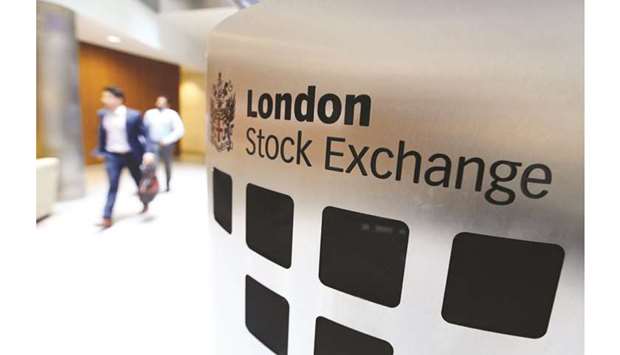
Visitors pass a sign inside the London Stock Exchange Group headquarters. The FTSE 100 shares index rose 0.1% to end at 7,632.24 points yesterday.