


Argentina is delaying payments on dollar-denominated notes until August 31 after calling on bondholders to negotiate a restructuring of its debt in “good faith.”
Some $9.1bn in payments on the local notes, known as Letes, will be affected, according to the Economy Ministry press office. Notes held by provinces and individuals will be exempted from the delay in payments, according to a government statement.
The decision is the second delay to payments on Letes in the past five months and illustrates the depth of problems facing the incoming government of President Alberto Fernandez. Argentina’s debt load stands at $332bn, including loans from the International Monetary Fund. Outstanding debt with private bondholders is about $148bn.
“The Letes re-profiling should be good for foreign currency bonds under foreign law as this reduces the government’s financing needs in dollars,” said Daniel Chodos, Credit Suisse’s Buenos Aires-based head of Latin America sovereign credit strategy. “However, it sets a bad precedence” indicating other local-law securities “could be re-profiled by decree.”
The delay won’t trigger a rating downgrade as it won’t change significantly the expected losses for bondholders, said Gabriel Torres, the primary sovereign analyst for Argentina at Moody’s. The rating firm downgraded the country to Caa2 from B2 in August and placed it under review for another downgrade.
“The biggest thing we are waiting for is what they will do with the medium to long term debt,” Torres said in an interview. “So far the message has been they will do everything they can to ensure fiscal consolidation.”
Investors anticipate the government will impose harsher terms on bonds held under Argentine law, a move that would limit an appeal to courts that are likely to be friendly towards the administration.
Argentine bonds traded slightly weaker on Friday, after rallying earlier in the week. The unofficial FX rate, known as the blue-chip swap, weakened 1.2% to 73.69 pesos to the dollar.
The renewed reprofiling of the local notes suggests the government may also attempt to roll over its peso-denominated debt, according to Alejo Costa Chief Argentina Strategist at BTG Pactual in Buenos Aires said.
“The decision only buys time,” Costa said. “It looks like they re-profiled the USD bills to August 2020 purely with the goal of offering a momentary alternative, as they need more time to build a plan.”
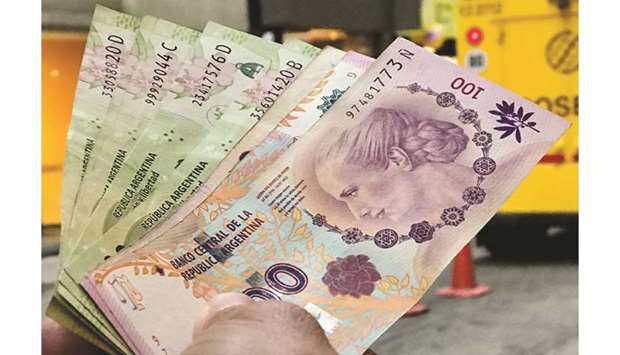
A man shows Argentine pesos outside a bank in Buenos Aires’ financial district (file). Investors anticipate the government will impose harsher terms on bonds held under Argentine law, a move that would limit an appeal to courts that are likely to be friendly towards the administration.