


China’s copper industry is walking the same treacherous path taken by steel and aluminium: rampant expansion that leaves smelters fighting weak profitability and production indiscipline.
China now makes about 40% of the world’s refined copper after a flurry of smelter construction over the past decade.
That’s slashed its need for imported metal, while boosting purchases of the raw material dug up everywhere from South America to Africa and Mongolia.
Its output of copper hit a record in November, as did volumes of the concentrate used to make it.
The industry faces a shakeup as smelters fight for market share on the one hand, and raw material supplies on the other, against a backdrop of slowing demand growth.
That jives with the experience of the steel and aluminium industries, both of which expanded relentlessly until supply overwhelmed demand and forced a painful period of restructuring.
“This is a characteristic of China’s industrial development, especially in these traditional industries,” said Helen Lau, an analyst at Argonaut Securities Asia. “Until you get massive, large-scale losses across whole industries, you will see continuous expansion. This is the usual way.”
Stresses are already emerging that could presage a shakeout of weaker players and a bout of consolidation.
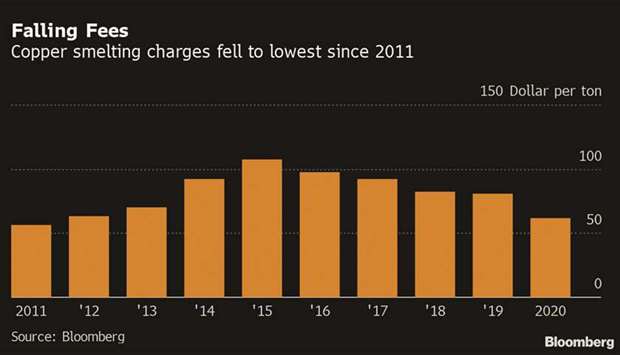
Raw material supply contracts with the world’s biggest miners for next year were the least favorable to Chinese smelters since 2011, and threaten to wipe out profits at higher-cost operations.
“We have now started to see smelter cutbacks due to financing problems,” said Nick Pickens, research director at consultancy Wood Mackenzie Ltd.
Capacity growth has seen more private companies enter the market in recent years.
They’re suffering the most, and are most likely to be forced out, he said. The fate of one particular smelter, Dongying Fangyuan Nonferrous Metals Co, has drawn scrutiny after it said earlier this month it’s experiencing cash flow tightness and is working with creditors to solve debt issues.
Its problems are apiece with a broader rise in credit risks across China as industrial profits swoon amid slowing growth.
The latest on Dongying Fangyuan is that it has failed to pay an instalment on a $430mn loan signed in March, according to people familiar with the matter.
The pressure on private producers echoes steel and aluminium, where larger, state-owned players have benefited from government-backed restructuring at the expense of smaller companies.
In steel, state-owned enterprises account for 15 of the biggest 20 producers.
Still, copper has a long way to travel to match the excesses of steel and aluminum, even if it’s marching in that direction.
China turned net exporter of both of those metals in the middle of the last decade, triggering massive trade frictions after swamping the world market with its exports.
For refined copper, China’s production only accounts for about three-quarters of its usage, according to Bloomberg Intelligence data, with imports needed to fill the gap.
And, China’s copper sector isn’t at this point headed for the kind of sweeping, government-backed reforms that have targeted unlicensed or environmentally harmful capacity in other sectors.
It’s also a metal that’s likely to see its traditional demand in pipes and wiring increasingly augmented by applications in clean energy, such as electric vehicle batteries.
“Copper is about 20 years behind aluminium and steel,” said John Johnson, chief executive officer of consultancy CRU Group’s China business. “They are still not in the position of being able to satisfy domestic supply, and we’re not calling for any move to a China surplus until well into the 2020s.”
.