


Bank of Japan chief Haruhiko Kuroda added his voice to the guarded optimism among major central bankers over the trajectory of global growth.
Progress in US-China trade talks, a stronger UK mandate for Brexit and an apparent bottoming of the manufacturing slump are easing concerns over a global slowdown that had triggered a wave of interest rate cuts across the world earlier in the year.
Jerome Powell has put the Federal Reserve on pause, Christine Lagarde has signalled the worst is likely over for the eurozone and now Kuroda has talked of an improvement in the risks surrounding growth.
In the case of Kuroda, he has managed to navigate through a precarious year without having to delve deeper into his depleted stock of ammunition.
Heading into 2020, extra easing hasn’t been entirely taken off the table for global central bankers including Kuroda, but the possibility of a long holding pattern followed by a firming of policy is now looking a lot more likely than it did at the end of the summer.
“Overseas risks have improved somewhat from a while ago and it’s true that we have seen relatively bright signs,” Kuroda said yesterday at a press conference a few hours after the BoJ kept its interest rates and policy guidance unchanged. “Still, the risks remain very high and we need to watch them closely.”
In the case of Kuroda he also has a $120bn government stimulus package to reassure his concerns.
The extra spending by Prime Minister Shinzo Abe’s administration aims to get the world’s third-largest economy back on track after a sales tax hike and a super typhoon hit consumption and production.
The governor said the package would have a positive impact on the economy, by supporting domestic demand and prices. “As we continue our massive monetary easing with yield curve control, I hope the synergy effects of a policy mix will be big,” Kuroda said.
The comment suggests that with the government taking more of a share of supporting the economy, the central bank will be looking to back off from taking further action barring a buckling of markets or a renewed deterioration in growth.
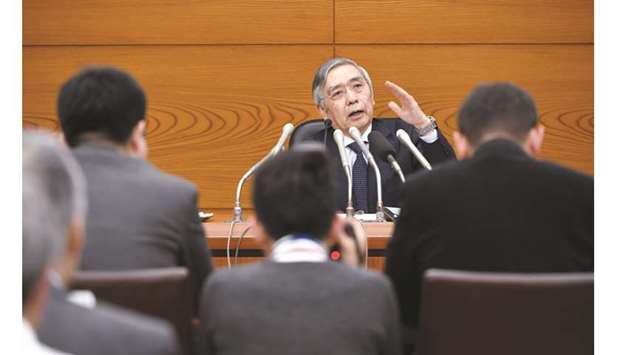
Governor of the Bank of Japan, Haruhiko Kuroda, speaks during his regular press conference at the BoJ headquarters in Tokyo. The bank held fire on monetary policy yesterday but hinted at possible interest rate cuts in the future, reflecting its fears that global risks could weigh on the country’s fragile recovery.