


It is the season of precedents and Pakistan is undergoing a few that appear to redefine the contours of the state. Many of these, to an outside observer, might seem like causing deep fissures but as evident in the last decade or so, the country has defied the odds not only to survive the doomsday prediction but, in effect, strengthen the evolving system.
It may take a special nerve to suggest this at a time when a special court has handed the death sentence to General (retired) Pervez Musharraf, the former army chief, who ruled the country from 1999-2008, in a case of high treason — which in itself was unprecedented — and the subsequent reaction from his institution, but one would wager on the apparent upheaval leading ultimately to a more rounded national template of accommodation.
The special court decision which has become a cause celebre — as well as the one relating to the extension of the current army chief which the Supreme Court gave its verdict on last month — has two outstanding dimensions — political and the legal one. A reasonably logical inference cannot be reached without taking both into account.
Let’s get to the legal one first, but with a backgrounder to understand where it’s coming from. The Musharraf case has roots in a classic battle of attrition he and the then-prime minister Nawaz Sharif were involved in following the Kargil war in 1999. Ironically, the former was handpicked over other senior generals to the powerful post by Sharif himself, but when rumours began to float about the PM having decided to sack him, the general reportedly put in place a contingent plan to overthrow him, if push came to shove. The script went exactly to plan as Sharif bungled in doing it behind the army chief’s back whilst he was returning from a foreign sojourn.
The ‘counter’ coup staged by Musharraf was eventually validated by the Supreme Court that year in line with what is known as the “doctrine of necessity” — a euphemism to describe what is strictly speaking, not within the ambit of or desirable under the law but dictated by circumstance. This of course, did no credit to the judiciary and remains a blot on its lily-livered approach to matters of highest constitutional calling in the past.
Interestingly, it is also one of a handful of key points of contention for his defence team: how was it “valid” back then in 1999, and not when he imposed a state of Emergency and suspended the constitution in 2007?
However, one of the foremost arguments expected to be advanced by the defence — as also pointed out by a few independent lawyers — in appealing the verdict pertains to the operative word “suspension”, which was added as part of an amendment made to the constitution (known as the 18th Amendment) by the subsequent ruling Pakistan People’s Party government with support from the opposition Pakistan Muslim League-Nawaz in 2010 after they forced Musharraf’s ouster from power with the ominous threat to impeach him. The (technical) implication is that Musharraf is responsible for his actions before then (2007) and so does not fall in violation of the treason act dictated by the more current application of law (2010).
That is not the only point of contention, of course. Defence lawyers claim the special court decision was reached without due process of law and affording the accused an opportunity to explain himself (the judges observed they had — at least six times!). It even challenged the jurisdiction of the court to hear the case.
The Musharraf case has run a gamut for six years and seen courts, judges, prosecutors and defence lawyers change. The prosecution team under the Sharif government, which initiated the case soon after returning to power in 2013, was more active for obvious reasons, but also saw the ex-general leave the country on medical grounds in 2016.
Musharraf is reportedly, critically ill and bed-ridden in a Dubai hospital.
The current government led by Pakistan Tehrik-i-Insaf (PTI) has been less keen on an “adverse” outcome — also for obvious reasons — and evidently used delaying tactics, the latest of which was to successfully appeal with the Islamabad High Court to stop the special court from issuing a verdict originally due last month on grounds that the defendant wasn’t given a fair opportunity to respond.
The new team of prosecutors tried — vainly — to push for including the names of the-then prime minister and interior minister amongst others to the list of co-accused in what the judges felt was just an attempt to prolong the case and indicated lack of intent on the part of the prosecution.
The ‘intent’ of the PTI government is apparent in what the Attorney General (AG) — the highest law officer of the state — said hours after the judgment in a presser. AG Anwar Mansoor Khan cited relevant clauses from law to suggest that even the case was “void from the beginning” in terms of jurisdiction and questioned “the rush” to reach the verdict. He also repeated the claim that the court had refused to entertain the submissions of the Additional Attorney General and a new team (of prosecutors) wanted to present as a result of the “unwillingness of the old team (under Sharif government)” to address the anomalies in the case.
Having said that the verdict, given the country’s chequered history, appears almost surreal. The swift — and again, unprecedented — reaction to a court verdict by the military spokesman shows how it was hitherto a ‘red line’. He was unequivocal in stating that Musharraf “can surely never be a traitor” having “fought wars for the defence of the country”. He expressed the institution’s “pain and anguish” over the ruling, took issue with how the case was conducted, saying, “the due legal process seems to have been ignored” and rounded off by expecting that “justice will be dispensed in line with the constitution”.
In a nutshell, a process of redefinition of the power structure that took roots in the lawyers’ movement in 2007 against Musharraf following his sacking of the chief justice is now headlong into the next gear. Clearly, the judiciary is asserting itself and the security establishment despite its reservations — and fury, in this case — may have to align with the changing realities. Last month’s ruling in the army chief’s extension case is a pointer, where again, the apex court issued a verdict to seek a constitutional recourse by putting an end to arbitrary decision-making.
The special court verdict is a milestone — where political dimension of the case is concerned — in that it puts to rest, for now, the theory that only popularly elected leaders are convicted. While it is highly improbable that Musharraf will return home given his ill-health and the verdict, or that the ruling will come to pass, it may create the firewalls to prevent future misadventures.
* The writer is Features Editor. He tweets @kaamyabi
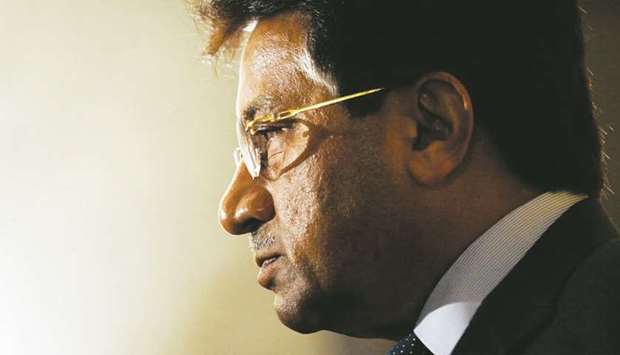
IN THE EYE OF A STORM: The verdict against General (retired) Pervez Musharraf is a contentious milestone, but one which may ultimately, come to redefine the contours of the state.