


Boeing is all set to launch its Starliner spacecraft for the first time to the International Space Station (ISS) at the end of this week, a key mission as Nasa looks to resume crewed flight by 2020.
This time around its sole passenger will be bandana-clad dummy Rosie, named after Rosie the Riveter, a campaign icon used to recruit women to munitions factory jobs during World War II.
“If we’re blessed with great weather, I look forward to a mission early on Friday morning, and then coming to the International Space Station on Saturday,” Kathy Lueders, manager of the National Aeronautics and Space Administration (Nasa)’s Commercial Crew Programme told reporters at the Kennedy Space Centre in Florida.
“The spacecraft is in really good shape,” added John Mulholland, vice-president and programme manager of the Boeing Commercial Crew Programme.
The US has relied on Russia to transport its crews to the ISS since the end of the Space Shuttle programme in 2011, but in 2014 hired Boeing and SpaceX under multi-billion dollar contracts, with the two companies already two years behind schedule.
Nasa is now targeting next year to start the flights, as long as the tests are completed without a hitch.
The mission that starts on Friday will last eight days and serves as a dress rehearsal.
The CST-100 Starliner, to give it its full name, will launch from Cape Canaveral at 6.36am local time (1136 GMT) on an Atlas V rocket built by the United Launch Alliance, and will reach the station 25 hours later.
Starliner will then remain docked for seven days before detaching and returning home.
It will land following a four-hour rapid descent in the New Mexico desert on December 28 at 3.46am local time (1047 GMT).
SpaceX’s capsule, known as Crew Dragon, undertook the same type of mission successfully last March.
The main difference is that Crew Dragon lands in the ocean instead of dry land – but both rely on parachutes to slow their descent.
Unlike in the past, Nasa is paying private companies for their services rather than owning the hardware, a move decided under former president Barack Obama and intended to save the taxpayer money.
As of May 2019, Boeing and SpaceX’s contracts were valued at $4.3bn and $2.5bn, with each company awarded six round-trip missions to the ISS.
Assuming four astronauts per flight, Nasa’s auditor estimated the average cost per seat at $90mn for Boeing and $55mn for SpaceX, compared to the $80mn paid to Russia for the same service.
Since neither company is confirmed as being ready for 2020, Nasa has begun negotiating the purchase of another seat with Russia for the fall of 2020, said Joel Montalbano, the agency’s deputy ISS programme manager.
The last confirmed seat for an American on a Russian ship is for April 2020.
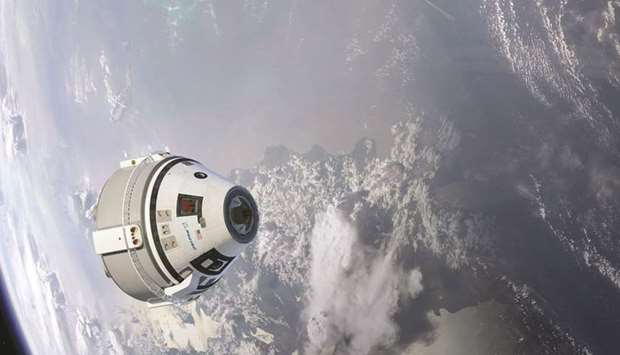
This Nasa/ Boeing handout image obtained yesterday shows an artist concept of a Boeing CST-100 Starliner in Earth orbit.