On the surface it was a classic leveraged takeover – $1.8bn of debt to fund the acquisition of Gannett Co. And just like hundreds before it, front and centre was Apollo Global Management.
Except this time, the private equity giant wasn’t the borrower. It was the lender. The deal is part of a major shift occurring in global finance. Direct lenders, including more and more hedge funds and buyout firms, are preparing to dish out billions of dollars at a time to lure borrowers away from the $1.2tn leveraged loan market.
It’s the latest push by alternative asset managers into what was once the exclusive territory of the world’s biggest investment banks. And while Wall Street voluntarily ceded much of its business lending to medium-sized companies in the aftermath of the financial crisis, this time the iron grip it has on arranging the industry’s bigger loans is being pried open, jeopardising some of its juiciest fees.
“Direct lenders have raised significant capital to allow them to commit to larger deals,” said Randy Schwimmer, head of origination and capital markets at Churchill Asset Management. “It’s an arms race.”
It’s a striking reversal of fortune for syndicated-lending desks that spent the last 10 years luring business away from the high-yield bond market, the original source of buyout financing for big, risky companies. Even as recently as the beginning of the year, deals in excess of $1bn were largely seen as the private domain of bulge-bracket banks, which arrange and sell them to institutional investors.
Not anymore. Apollo said last month that it’s looking to do deals in the $2bn range. Rival Blackstone Group is actively pitching a trio of billion-dollar financings that it intends to hold entirely itself, according to a person with knowledge of the matter.
And private-credit standouts including Owl Rock Capital and HPS Investment Partners are also setting their sights on bigger loans. The August financing of New Media Investment Group’s acquisition of Gannett came on the heels of a $1.25bn direct loan by Goldman Sachs Group’s private-investment arm – one of the few of its kind under a Wall Street bank – and HPS to fund Ion Investment Group’s purchase of financial data provider Acuris.
And in October, a group of about 10 lenders including Owl Rock banded together to provide a $1.6bn loan to refinance the debt of insurance brokerage Risk Strategies.
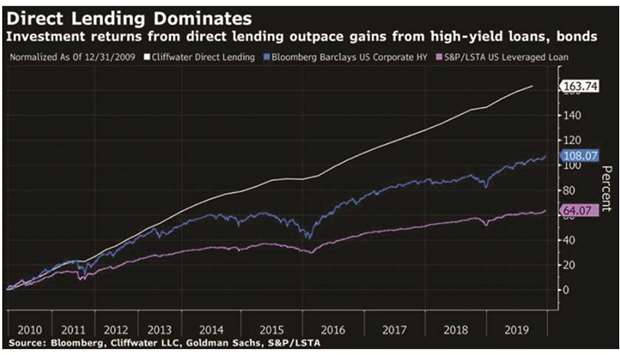
“There are bigger pools of capital” now, said Craig Packer, co-founder of Owl Rock, which controls more than $14bn. “Our holdings of individual loans are therefore larger than was previously available from smaller lenders.” Fading Fees Investors have ploughed hundreds of billions of dollars into private debt funds in recent years, lured by premiums that are more than five percentage points higher than competing public debt, according to a Goldman Sachs analysis.
Assets under management now exceed $800bn, based on the most recent data available from London-based research firm Preqin, including over $250bn of dry power. In contrast, leveraged loan growth has begun to stall, with the size of the US market now hovering around $1.2tn, up less than 4% from a year earlier.
Partly as a result of direct lenders increasingly allowing borrowers to bypass the syndication process, compensation for arranging leveraged loans has plunged. Fees are down 29% this year through November, to about $8.5bn, versus the same period last year, according to Freeman Consulting Services estimates.
The biggest players in the industry say the shift is just getting started. Apollo predicts as much as 10% of the more than $2.5tn high-yield loan and bond market will go private over the next five years, John Zito, co-head of global corporate credit, said at the company’s November 7 Investor Day.
The alternative asset manager sees the privatisation of global credit mirroring a similar trend that’s swept equity markets in recent years. In fact, many say the continued expansion of private equity will only help fuel the growth of direct lending.
“As private equity capacity increases, more deals and larger deals are being done in the private space,” Benoit Durteste, chief executive officer of Intermediate Capital Group, said in a report by the Alternative Credit Council last month. “This is why we are seeing larger and larger deals in private debt and the limits keep on being pushed.” Growing execution risk in the leveraged loan market is also prompting buyout firms to increasingly turn to private sources of financing, according to market participants.
Loan buyers have been drawing a line and either bypassing or demanding significant concessions to lend to companies that may struggle in an economic downturn.