


A European group has uncovered a network of obscure NGOs and think tanks that assist over 200 “fake” news outlets managed by an Indian network to influence the European Union and the United Nations with content critical of Pakistan.
The “EU DisinfoLab” is focused on researching and tackling sophisticated disinformation campaigns targeting the EU, its member states, core institutions, and core values.
The non-governmental organisation (NGO) in its initial findings earlier in November had uncovered a network of 265 “fake” news outlets managed by an Indian network to influence the EU and the UN with content critical of Pakistan.
During the investigation, the DisinfoLab found that the fake websites copy-pasted anti-Pakistan content from unusual press agencies and amplified material shared by politicians and obscure think tanks that supported Indian geopolitical interests.
They republished anti-Pakistan content on the rest of the Indian network, including fake outlets such as “EP Today”, “Times of Geneva”, and “New Delhi Times”.
Most of the websites had Twitter presence as well.
The investigation discovered that the “news” outlets were managed by Indian stakeholders, with ties to a large network of think tanks, NGOs, and companies from the Srivastava Group.
In its full report, the EU DisinfoLab also detailed offline efforts of the Indian network assisted by “fake” NGOs and organisations responsible for anti-Pakistan lobbying events in Europe.
The events were then given media coverage by the “fake” news outlets.
The report also highlighted various obscure groups that had been co-ordinating demonstrations and social media campaigns against Pakistan every year during UN Human Rights Council sessions.
They used the hashtag for Human Right Council’s live broadcast on each occasion.
According to the report, behind all the campaigns organised in Geneva against Pakistan on the subject of the treatment of minorities were the organisations EOPM (European Organisation for Pakistani Minorities) and VOPM (Voice of Pakistani Minorities).
The issues raised in the campaigns were meant to steer criticism towards Pakistan for the state of minorities and persecuted groups in the country.
For instance, in March 2017, the EOPM organised a three-day photo exhibition in Onex to highlight the issue of “atrocities” against Christians in Pakistan.
Later in September 2017, a campaign titled #StopPakistan was launched to raise women’s rights in the country during the 36th session of the UN Human Rights Council.
The organisation also issued a press release on the campaign.
It reads: “The initiative has been taken during the 36th session of Human Rights Council in Geneva by Pakistani Women Human Rights Organisation and European Organisation for Pakistani minorities (EOPM).
“The European Organisation for Pakistani Minorities, an NGO, has displayed its posters on taxi bikes.”
The group also organised the #PakistanStopGenocide campaign on September 10 this year, in front of the United Nations in Geneva, while the 42nd session of UN Human Rights Council was under way.
This campaign was about Baluchistan, and as had been the case with the other ones, it involved pitching a tent, having the hashtag in big letters in front of the UN in Geneva, and speeches and conferences by members of the network.
The report found that some Members of the European Parliament (MEPs) had engaged directly with the Indian network through various channels such as contributing to their media coverage, participation in conferences, or by speaking in the European Parliament on behalf of their cause.
One such individual mentioned in the report is Madi Sharma, who also goes by the name Madhu Sharma, a British member of the European Economic and Social Committee (EESC) since 2002.
She has written for “EP Today” and the “New Delhi Times” as their “EU correspondent”.
She also sent MEPs invitations for a controversial trip to Indian-administered Kashmir amid ongoing restrictions.
The investigation found that these demonstrations were covered by the network of “fake” news outlets run by the Indian company, Srivastava Group.
In fact, all of these websites had copy-pasted the same content from the very same sources, with those being “EP Today”, “Times of Geneva”, 4newsAgency, and “New Delhi Times”.
On April 30 this year, 51 MEPs issued a collective letter addressed to Prime Minister Imran Khan, expressing their concerns and seeking assurances that the persecution of religious minorities would cease immediately.
The letter and the signatories were published on “EP Today”.
From studying the content of one of the fake news outlets – “Times of Geneva” – the European group’s report observed that themes and style of the demonstrations that they covered were similar and focused to discredit Pakistan such as campaigns to “stop [insert minority] genocide”, were held at the same time as UN Human Rights Council sessions, and complemented by “Times of Geneva” side-line interviews on the demonstrations with the same recurring figures.
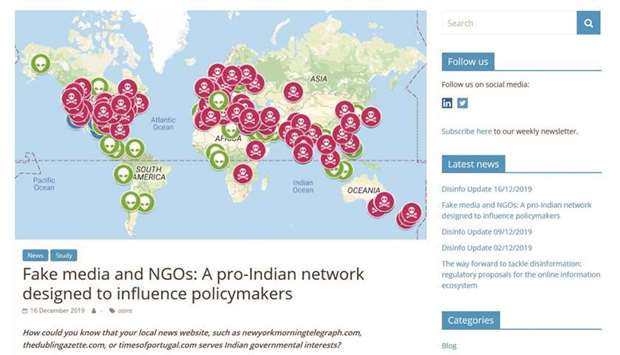
The webpage showing the EU DisinfoLab report.