


The 4th Association of Sports Institutes in Asia (ASIA) congress got off to fine start at the Aspire Academy yesterday, with Qatar national football coach Felix Sanchez holding the fort with his wisdom. Sanchez said Qatar’s victory in Asian Cup in January this year has hugely impacted the development of sports in the country.
“Qatar and Aspire Academy’s strategy in choosing to be patient in building and developing a team rather than go for immediate results has proved to be worthwhile. This pathway has made other sports in the country seek to emulate this approach,” said Sanchez during a discussion.
During the same session, Dr Alberto Mendez-Villanueva, who is the head of Fitness at Qatar Football Association and works closely with Sanchez, sought to correct the misunderstanding in some quarters about challenges presented by training during Muslim holy month of Ramadan.
“Contrary to the notion out there amongst some that there can’t be training during Ramadan, we in Qatar have come to appreciate and understand that is not the case. What we do is to adjust the training times to when it’s best to train just as intense as any other period but in consideration of the fasting time period observed by players,” Mendez-Villanueva said.
“So, for instance we have full training at night with the players applying themselves like at any other time, so from this perspective you can see how time of Ramadan has often been misunderstood or should l say misrepresented,” he added.
The event was officially opened by Aspire Academy Deputy Director General and Chairman of the 4th ASIA Congress, Ali Salem Afifa. In his welcoming speech to the participants, Afifa encouraged the congress to continue sharing the development of a high-performance environment for aspiring athletes on the continent of Asia.
The President of ASIA, Dr Takahiro Waku in his opening address expressed his gratitude and delight to be in Qatar at the world renowned Aspire Academy. “On behalf of the Association of Sports Institutes in Asia, l want to thank the people of Qatar and Aspire Academy for hosting us at this fabulous institution. We are aware of the role Aspire Academy has been playing in Qatar’s rise as a sporting giant in the world and we are most pleased to hold our 4th Congress here,” he said.
Waku and his deputy Toh Boon Yi went on to inaugurate the two new members of ASIA, namely Chengdu Sports University from China and Cambodia’s National Institute of Physical Education and Sport.
The Congress also heard from Aspire Academy graduate and Qatar’s No 1 Squash player Abdulla al-Tamimi and his coach former and World No 1 Geoff Hunt. “What stands out for me in my journey in my sport so far is how the realisation that through the national sport development programs the country has started in several places – in my case it was at Aspire Academy and where l working with coach Geoff Hunt l came to realise the opportunities to apply myself fully to be the best l could be in my sport,” al-Tamimi, who is currently 46 in the World, said.
The founding members of the Association of Sports Institutes in Asia – the Japan Sports Council, Singapore Sports Institute, Hong Kong Sports Institute and Aspire Academy then made a presentation on the topic of transitioning of athletes from youth to senior from senior. “Singapore is a small nation of about 3.5mn people and we decided to prioritise the sports to develop and play and we feel this optimises the resources and energies and is more likely to bring us the goals we are aiming for,” said Dr Su Chun Wei of the Singapore Sports Institute.
According to Dr Daniel Lee from Hong Kong Sports Institute, Hong Kong has 500 full time athletes and relies on the coaches and trainers in deciding and determine when the youth are ready to transition to senior competition.
“The vision for Hong Kong Sports Institute is to create a suitable environment and support to train and develop athletes. That’s what we do and see our role as coming alongside the professionals working with the athletes to ensure the transition is smooth and brings the best desired goals for the athletes,” said Dr Lee.
As for the Japanese approach, Dr Takahiro Waku said: “The journey to preparing the athletes from youth to senior in Japan is constantly being monitored and institutes of high performance are leading the way in research and documenting some of the findings from which the Japanese Sports Council then formulates policy in line with approaches found to work better for our athletes”.
Meanwhile the afternoon session opened with a captivating presentation by Dr Duncan Simpson, the head of mental conditioning at IMG Academy. The developmental academy has an enrolment of about 1,200 students across multi sports starting from age 8-18. IMG Academy is quite like Aspire Academy and Dr Simpson was keen to emphasize that each institution will have to craft what works for its goals and objectives just as IMG has found through an ongoing process over the 42 years since it was founded. “At IMG we looked at Multidisciplinary versus Interdisciplinary approach and settled for Interdisciplinary because with this approach there is more collaboration which is crucial for any high-performance environment, said Dr Simpson
Today on Day 2 of the ASIA Congress, the topic of Implementation of Sports Technology research and innovation into performance programmes and a series of presentations will be made.
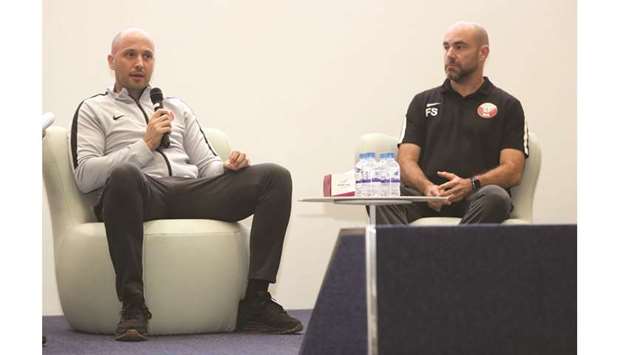
Qatar’s football coach Felix Sanchez (right) and Dr. Alberto Mendez-Villanueva, head of Fitness at Qatar Football Association, speak during the 4th Association of Sports Institutes in Asia congress at the Aspire Academy yesterday.