


Qatar National Library has held an international conference and exhibition on Gulf architecture, organised in collaboration with Liverpool University’s School of Architecture, Qatar University (QU)’s Department of Architecture and Urban Planning, and Ibrahim Jaidah, CEO and chief architect, Arab Engineering Bureau.
The exhibition opened at the library on October 10 and continued for the rest of the month. The conference was held from October 11-13. These events announced the start of the library’s recently-launched Gulf Architecture Project (GAP).
GAP is a collaborative project between local and international partners to create an online digital collection of historical photographs, films and audio recordings, drawings, maps, and 3D models of the architectural heritage of Qatar and the Gulf region, with supporting research and publications, for the Qatar Digital Library (www.QDL.qa), the largest digital archive on the Middle East, operated by the library.
Experts from ArCHIAM, a leading research centre for the study of Islamic historical environments based at Liverpool University’s School of Architecture, are working with key members of Qatar’s architecture community to digitise international archival collections on Qatari and Gulf architecture for the Digital Library.
Key Qatari partners in this project include Jaidah; Mohamed Ali Abel, head of the Architectural Department at the Private Engineering Office; QU’s Department of Architecture and Urban Planning; the Urban Planning Department of Qatar’s Ministry of Municipality and Environment (MME); Qatar Foundation; and Qatar Museums.
The project’s conference brought together some of the world’s leading experts on Gulf architecture to present their latest work, share their expertise and attend the project’s exhibition. This year’s conference and exhibition were the second to be held at the library, but the first since the project was launched.
“I am honoured to be invited to actively participate in this long-awaited project. As a member of the project’s Advisory Committee, I envision that the digital collection on Qatari and Gulf architecture will provide easily accessible materials to the Qatar Digital Library’s national, regional and international audiences,” Jaidah said:
“Department of Architecture and Urban Planning (DAUP) faculty, staff and students will be an important part of this project, devoting their experience, knowledge and motivation to make it a success. It will offer them a stage to showcase their recent projects, expertise and experience in digitising Qatar’s architectural heritage,” said DAUP head Dr Fodil Fadli.
Professor Soumyen Bandyopadhyay, Sir James Stirling Chair in Architecture at the Liverpool School of Architecture, who attended the event, said: “The Gulf Architecture Project aims to enhance our knowledge of Gulf architecture and urbanism. The exhibition is an important part of the project. By drawing on content from across the Gulf region – maps, drawings, photographs, digital models – this exhibition brings together our initial findings on how these societies transformed landscape and developed infrastructure and settlements.”
Mohamad Hussain Ali al-Sayegh, who attended the conference, added: “The Gulf Architecture Project is important in many ways. It will help with urban planning in Qatar and help us preserve the heritage of the country. We are thankful to the library for organising such a unique conference. It was a useful opportunity to meet experts in traditional architecture from Qatar and the region.”
Among other topics, speakers at the conference discussed the importance and the role of digitisation and public awareness about the preservation of architectural heritage, including Qatar’s early modern architecture from 1950-1970s.
Ali Abd Alraouf, professor of Architecture and Urbanism and Research Co-ordinator at the Urban Planning Authority at the MME, said: “I am honoured to contribute to this conference on Gulf architecture and heritage, which has contributed to the development of the modern state. Qatar’s traditional architecture has a distinctive urban and architectural identity among others in the world.”
“I am glad that the library is staging such informative events. This conference was an excellent opportunity for practitioners in the field of architecture to study Qatar and the region’s heritage and hear from world-class experts on how to preserve that valuable history,” said participant Shaima Sharif.
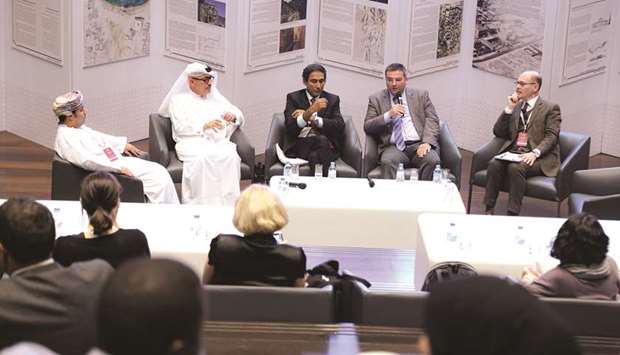
Dignitaries at the conference.