


Qatar Red Crescent Society (QRCS), Bangladesh Red Crescent Society (BDRCS), the World Health Organisation (WHO) and Bangladesh Blood Bank co-organised a training course on basic and safe blood transfusion services, for 120 professionals from health facilities.
The three-day event covered topics and professional skills related to blood transfusion, including the mechanisms to select lower-risk donors and patients, donor registration procedures, how to collect blood samples, testing, storage, preservation, safe transfusion and government policies of the Blood Bank. During the opening ceremony, the head of QRCS’s mission in Bangladesh welcomed the participants and organisers.
He valued the co-operation from partners, wishing that the course would attain the desired goals of raising awareness and capacity-building among local health workers, in a manner that improves health services for both the refugees and local community.
According to him, the training is the first of its kind in Cox’s Bazar, attracting a selection of medical experts in Bangladesh to establish blood donation and transfusion services.
This way, the collected blood will be distributed to Cox’s Bazar hospitals, which had to bring it from the capital, Dhaka, earlier with extra transportation and preservation costs.
The training course is part of a project to develop the BDRCS field hospital in Cox’s Bazar, which hosts around 1mn refugees from Myanmar, as well as the host community.
It is the product of co-ordination among the Bangladeshi health authorities, BDRCS, QRCS, the International Federation of the Red Cross and Red Crescent Societies and WHO. The partners work together to upgrade the health care system at the refugee camps.
Supported by QRCS, the field hospital is the only blood transfusion service provider.
With this training, the hospital will be able to collect, preserve and supply blood directly to the hospitals and health centres of Cox’s Bazar.
The strategic goal is to secure constant blood supply at the field hospital, as well as the other field hospitals that receive their monthly ration from it.
Thus, the training helps qualify medical professionals to do the work and make sure that the blood preservation, transportation and transfusion processes are done properly and safely, QRCS has said in a statement.
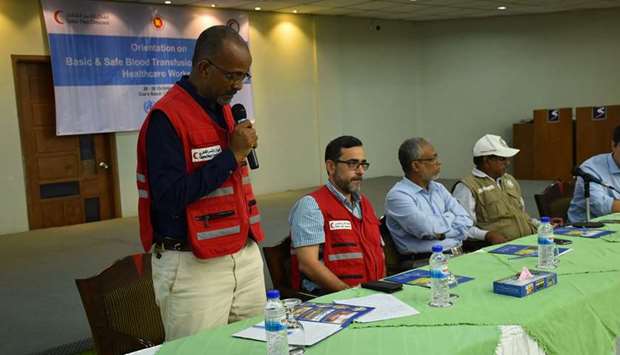
Snapshots from the training course.