


Some doctors and residents urged New Delhi authorities to shut schools and cancel outdoor sporting events in the Indian capital as air pollution remained at the most severe level for the second day running yesterday.
Farm fires raging in neighbouring states have sent clouds of smoke floating over the city, trapped in a toxic smog, posing a health risk to its 20mn residents, according to the Central Pollution Control Board’s (CPCB) air warning guidance.
The CPCB air quality index (AQI) has exceeded 400, classified as “severe” on the scale, which means it can seriously affect those with existing respiratory illnesses, and even those who are healthy.
Pollution readings in some places had peaked at 500, the most severe level on the government index.
“It is a public health emergency,” said Desh Deepak, a chest physician at the city’s Ram Manohar Lohia Hospital.
“Today, lungs are far blacker compared to 20 years ago.”
Hospitals across the National Capital Region have reported a rise in visits of patients, with most complaining about respiratory and eye problems.
“After Diwali, smog brings a lot of medical problems in Delhi, especially in kids. In our hospital, we have witnessed a rise in the number of people with respiratory and eye problems,” Arvind Aggarwal, a doctor at Sri Balaji Action Medical Institute said.
“We have witnessed 20-22% increase in OPD visits, where the patients are facing symptoms associated with pollution like irritation in the eyes and throat, dry skin, skin allergy, chronic cough and breathlessness,” Aggarwal said, adding that the asthmatic patients, elderly and children should try to stay indoors.
According to Navneet Sood of Dharamshila Narayana Superspeciality Hospital, people should see a doctor if they experience symptoms like redness in eyes, breathing problems, uneasiness, and frequent headaches.
“We have witnessed visits by 15-16 patients on a daily basis after Diwali. Three-fourth of the cases were related to the worsening of asthma and chronic obstructive pulmonary disease or COPD. Rest one-fourth of the cases were for bronchitis,” Sood said.
Delhi’s air quality took a hit after Diwali night due to a combination of firecracker emissions, stubble burning and unfavourable meteorological conditions.
Since then, pollution levels have been oscillating between the lower and higher ends of the “very poor” category.
Some citizens’ groups and doctors took to Twitter to call for schools to be temporarily closed until the air quality improved.
Former cricket captain Bishan Singh Bedi, meanwhile, led a chorus of warnings over Delhi hosting a limited-overs Twenty20 cricket match between India and Bangladesh on Sunday, citing “hazardous air quality”.
But match organisers at the Delhi & District Cricket Association announced the sale of tickets yesterday in a sign they were pressing ahead.
Delhi’s Chief Minister Arvind Kejriwal said: “I hope that pollution will not come in the way of cricket.”
Some residents also called for the cancellation of a 6km run planned for today to mark the anniversary of the birth of former home minister Sardar Patel, revered by the Bharatiya Janata Party.
“You will be putting thousands of citizens in harm’s way by making them run in this pollution,” posted Brikesh, a Twitter user.
The CPCB index measures the concentration of tiny poisonous particulate matter that can be carried deep into the lungs, causing deadly diseases including cancer and cardiac problems.
“We are in a severe situation because there are no winds,” Prashant Gargava, a top official at the CPCB said.
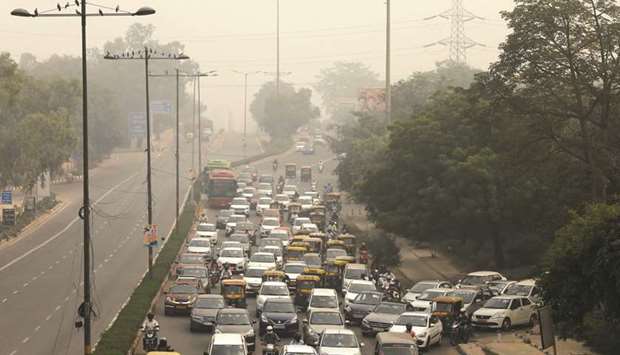
Vehicles drive through smog in New Delhi yesterday.