


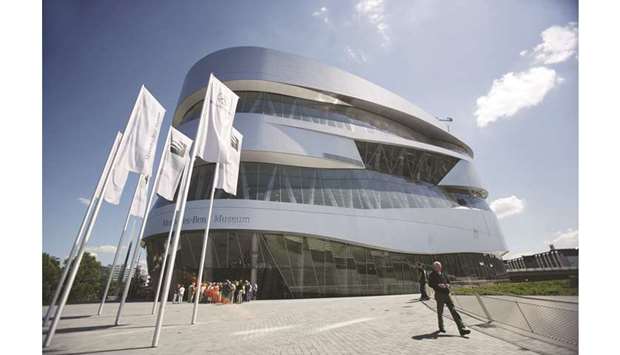
German carmaker Daimler reported yesterday a return to quarterly profits in July-September after its first three-month loss in 10 years, but said more work was ahead as it confronts a slowing global market.
“Strong sales” at the Mercedes-Benz maker helped lift net profits 3% year-on-year, to €1.8bn ($2.0bn), chief executive Ola Kallenius said.
But the recently-installed boss reiterated that the Stuttgart-based firm must continue cutting costs to be fit for the future.
Revenues were up 8%, at €43.3bn, with operating or underlying profit growing at the same pace, to 2.7bn.
“Daimler beat market expectations for sales, operating profit and net profit,” noted analyst Frank Schwope of LBBW bank.
“The car division stabilised significantly and the final quarter this year should be better than in 2018,” he forecast.
Over the full year, Daimler confirmed that it expects revenue “slightly above” 2018’s level, while operating profit will be “signficantly below” last year’s €11.1bn.
It has already lowered expectations twice, hit by recalls over alleged diesel cheating and faulty Takata airbags as well as weaker-than-expected growth in the global car market.
Volvo Cars
Volvo Cars reported a sharp rise in third-quarter revenue and profits yesterday helped by cost savings, but also sees market conditions continuing to pressure margins this year.
Volvo, part of China’s Geely group, said its quarterly operating profit rose 90% to 3.49bn crowns ($362mn), with revenues improving by 14% to 64.8bn crowns.
Its results were also boosted by strong demand for its SUV models.
It said its sales growth had outpaced the industry in Europe, China and the United States, as it sold 166,878 cars globally in the quarter.
“The growth in unit sales, revenue and profit was driven by a strong demand for our SUV range as well as cost efficiency,” Chief executive Hakan Samuelsson said in a statement.
Volvo — which said in July it would cut fixed costs by 2bn crowns with measures to be completed by the first half of 2020 — aims to produce premium cars to rival BMW and Daimler’s Mercedes-Benz.
It repeated yesterday that market conditions would continue pressuring margins this year, but that volume growth and cost measures would boost profits in the second half compared with the same period last year.
Volvo said it expected a slightly lower level of capital expenditure, after an intense period of investments in its global footprint and new technologies.
Group 1 Automotive
Group 1 Automotive Inc posted a far better-than-expected quarterly profit yesterday as strong US demand offset weakness in other markets, sending shares of the No 3 US auto dealership soaring as much as 16% to an all-time high.
J.P. Morgan analysts said in a research note the results were well above expectations, calling out “solid execution” in the US market despite struggles in its British and Brazilian markets.
They said the British market was weak for the company but better than expected.
Group 1 still expects the US auto industry to finish this year at 17mn in new-vehicle sales and finish somewhere in the 16.5mn to 17mn range next year, chief financial officer John Rickel said in a telephone interview.
“If you look where the consumer is in the US, they’re still pretty upbeat,” he said.
Group 1’s net income in the second quarter rose more than 9% to $38mn, or $2.04 a share, from $34.8mn, or $1.74 a share, in the year earlier quarter. Excluding one-time items, Group 1 earned $3.02 a share.
Analysts were expecting $2.72 a share, according to IBES data from Refinitiv.
Revenue rose 7.9% to $3.12bn, above the $2.95bn analysts had expected.
The Houston-based company, with dealerships in the United States, Britain and Brazil, reported a 7% increase in gross profit as revenue from new-vehicle sales rose 7.3%, and retail used-vehicle revenue increased almost 10%. US operations accounted for almost 78% of total revenue and about 83% of gross profit, while British operations accounted for almost 19% and 14%, respectively. Same-store revenue rose 9.7% in the United States, while it fell 2.3% in Britain.
Comcast
Comcast Corp beat Wall Street profit and revenue estimates yesterday, as the company added high-speed internet customers and lost more video subscribers than expected.
Comcast’s third quarter showed that its focus on the higher-margin broadband business — necessary to stream content — is helping to offset a decline in cable subscribers.
Revenue from the company’s high-speed internet business grew 9.3% to $4.72bn with the gain of 379,000 subscribers in the quarter, beating analysts’ average estimate of 344,000 net additions, according to research firm FactSet.
Comcast’s results also reflected the widespread “cord-cutting” across the cable business.
The company lost 238,000 video customers in the three months ended September 30, higher than the 224,000 it lost in the previous quarter, above the 203,000 loss estimated by research firm FactSet.
In September Comcast announced it will offer Xfinity Flex, its streaming media set top box, and a voice remote for free to its US internet-only customers.
It had previously charged those customers $5 per month for the service and remote.
The product is meant to make it easier for subscribers of multiple streaming services to find shows.
The company’s NBCUniversal business, which includes NBC Entertainment and Universal Pictures, reported revenue of $8.30bn, down 3.5% from a year earlier.
In April NBCUniversal is launching a streaming service called “Peacock,” which will be available as a subscription or with ads, stocked with 15,000 hours of content from the company’s library.
British pay-TV group Sky, which Comcast acquired after outbidding Twenty-First Century Fox last year, generated revenue of $4.55bn, missing estimates of $4.75bn.
Comcast attributed that miss to tough macroeconomic conditions in the UK, Germany and Italy.
The Philadelphia company said revenue rose 21.2% to $26.83bn, beating analysts’ average estimate of $26.77bn, according to IBES data from Refinitiv.
Net income attributable to Comcast rose to $3.22bn, or 70 cents per share, from $2.89bn, or 62 cents per share, a year earlier.
Excluding items, the company earned 79 cents per share, ahead of estimates of 75 cents.
Twitter
Twitter shares plunged yesterday after reporting glitches that impacted its ad-targeting ability, pulling down revenue growth in the past quarter.
Profit for the third quarter was $37mn, a sharp drop from last year when the online messaging platform was helped by a large tax benefit.
Revenue rose 9% from a year earlier to $824mn, well below analyst forecasts, impacted by what the company called “revenue product issues.”
Twitter said revenue was hit by “bugs” which made it harder to deliver targeted advertising, as well as some seasonal factors.
“Unfortunately we had some missteps and bugs,” chief executive Jack Dorsey told a conference call.
“These are issues we identified quickly and are working quick to fix.”
Chief financial officer Ned Segal said Twitter is working on a fix but that the glitch is expected to have a negative impact in the fourth quarter.
The bugs mainly affected Twitter operations outside the United States, where ad revenue was up just 5% compared with 11% for the US.
Overall, advertising revenue totalled $702mn, up 8% from last year.
Equinor
Equinor’s third-quarter profit fell by more than expected yesterday after a significant decline in the volume and price of natural gas sold to Europe, although the Norwegian firm reiterated its forecast for flat 2019 production.
Equinor’s Sverdrup oil field, which only started in early October, has already achieved a daily production above 200,000 barrels, and will have a capacity of well above 300,000 barrels by the end of November.
Equinor’s adjusted earnings before interest and tax (EBIT) fell to $2.59bn in the third quarter from $4.84bn during the same period in 2018.
A poll of 23 analysts compiled by Equinor forecast adjusted EBIT of $2.69bn. “We maintain strong cost and capital discipline, but our results are affected by lower commodity prices in the quarter. In addition, we have decided to use our flexibility to defer gas production to periods with higher expected prices,” Equinor’s chief executive Eldar Saetre said.
Equinor’s total equity oil and gas production was 1.9mn barrels of oil equivalent per day in the third quarter, down 8% from the same period in 2018.
Gas production off Norway alone fell by 17%, while average invoiced European gas prices were down 26%.
Equinor had made impairment charges of $2.79bn, with $2.24bn related to its onshore shale oil and gas assets in North America on “more cautious price assumptions”.
Nordea
Nordea, one of the Nordic region’s biggest lenders, swung into the red in the third quarter, surprising analysts and adding pressure on new CEO Frank Vang-Jensen as he seeks to revive profitability.
It was the first loss since Nordea was created as the result of a bank merger in 1998.
The bank, which also set out Vang-Jensen’s financial strategy yesterday, had already been seeing profits decline due to low interest rates and tough competition in mortgages and loans.
In the third quarter Nordea said it faced one-off charges totalling €1.3bn ($1.5bn), resulting in an overall operating loss of €421mn for July-September.
That compared with analysts’ expectations for a €905mn profit, according to a Refinitiv poll of six analysts.
Since Vang-Jensen took over as CEO last month, the bank has announced the departure of three senior executives including its finance chief and its chief operating officer as the bank looked to revise its leadership.
Yesterday, it set a target to achieve a return-on-equity target of above 10% in 2022, a cost-to-income ratio of 50%, a management buffer of 150-200 bps above the regulatory CET1 requirement and a dividend payout ratio of 60-70%, both starting from 2020.
Coca-Cola European Partners
Coca-Cola European Partners Plc said yesterday it had a slower-than-expected start to its fourth quarter due to weakening demand in France and Britain, as well as cold weather in October in most markets.
The world’s largest independent bottler of Coca-Cola drinks expects to report full-year diluted earnings per share growth of about 10%, compared with its prior forecast of between 10% and 11%. The company forecast full-year revenue to grow about 3%, excluding the impact of soft drinks taxes of about 1%. It had previously expected the growth to be in a low single-digit range.
Coke European Partners, which sells and distributes drinks in 13 European countries, reported €3.28bn ($3.65bn) in revenue for the third quarter ended September 27, compared to €3.29bn a year earlier.
Separately, it also said it will take a 25% stake in Kol, an on-demand delivery service in Paris, and a 15% stake in self-driving technology company TeleRetail through its investment fund.
Norwegian Air
Norwegian Air said yesterday it has struck a deal with China’s CCB Leasing to take joint ownership of 27 Airbus aircraft on order and reported earnings for the peak summer holiday season above expectations, boosting its finances.
The cash-strapped carrier has for months said it aimed to find a partner to help take ownership of the Airbus fleet, allowing Norwegian to cut its debt and increase its equity.
CCB Leasing Corp DAC (CCBLI), a wholly owned subsidiary of China Construction Bank Corp, will own 70% of the joint venture, while Norwegian Air’s Arctic Aviation unit will own the remaining 30%. Under the terms of the agreement, the joint venture will purchase an initial 27 Airbus A320 NEO aircraft from Arctic to be delivered from 2020 to 2023.
Net profit for the third-quarter came in at 1.67bn crowns ($183mn), beating the average analyst forecast in a Refinitiv poll for a profit of 1.47bn crowns and up from a profit of 1.30bn crowns a year ago.
The firm cut its 2019 capital expenditure guidance by $200mn this year to $1.0bn, while raising it by $100mn to $1.4bn for next year.
It also narrowed its 2019 guidance for earnings before interest, taxes, depreciation, amortisation, and restructuring (EBITDAR), excluding other losses or gains, to about 6.1-6.5bn crowns, from earlier guidance for 6-7bn.
Schneider Electric
Schneider Electric yesterday posted an organic revenue growth of 3.1% in its third quarter, underpinned by strong performances in its energy management segment.
The company, which markets products ranging from electrical car chargers and lighting control to transformers and software, said its third-quarter revenue came in at €6.64bn ($7.39bn), above a company-compiled consensus of €6.61bn.
The group, active in the production and distribution of electrical components and automation systems, said it expects China to remain a growing market although construction end-markets could soften, affected by trade tensions with the United States.
DNB
Norway’s DNB said yesterday it will begin a new share buy-back program as it reported third-quarter results above expectations.
Norway’s biggest bank earned a net profit of 6.06bn Norwegian crowns ($664.2mn) for the July-September period, up from 5.67bn last year, beating the average forecast of 5.46bn in a Refinitiv poll of analysts.
DNB had warned in September that it’s third-quarter result would be hit by a 1bn crowns loan loss provision related to one of the bank’s customers.
Norwegian business daily Finansavisen reported at the time that the loss stemmed from the collapse of tour operator Thomas Cook, although DNB has declined to comment on the origins of the provision.
Microsoft
Microsoft Corp on Wednesday forecast sales for its cloud computing services that topped analysts’ estimates, even as quarterly growth slows for its Azure business.
Microsoft said it expected “intelligent cloud” revenue of $11.25bn to $11.45bn for its fiscal second quarter, above analysts’ consensus of $11.2bn, IBES data from Refinitiv showed.
Revenue from Azure grew 59% in the fiscal first quarter ended September 30, well below the 76% in the year-ago period and slightly short of analysts’ estimates.
Worldwide spending on cloud infrastructure services grew nearly 38% year-on-year in the calendar second quarter to $26.3bn, according to data from research firm Canalys.
Microsoft beat Wall Street expectations for its overall revenue and its intelligent cloud segment, which contains Azure, marking $33.1bn in overall sales and cloud unit sales of $10.8bn.
The technology company’s personal computing division accounted for the largest share of its first-quarter revenue posted on Wednesday, rising 4% to $11.13bn.
The unit includes Windows software, Xbox gaming consoles, online search advertising and Surface personal computers.
Windows results were boosted by 19% revenue growth for business computers, which was offset by a 7% decline for consumer PCs.
Mike Spencer, head of investor relations for Microsoft, said Google Chromebooks continued eat into Windows revenue for entry-level laptops.
But Microsoft forecast current-quarter revenue of $12.6bn to $13bn for the personal computing division, below analysts’ consensus estimate of $13.38bn.
Net income rose 21% to $10.68bn, or $1.38 per share, while total revenue rose 14% to $33.06bn.
Analysts had expected a profit of $1.25 per share on revenue of $32.23bn, according to IBES data from Refinitiv.
Ford Motor
Ford Motor Co on Wednesday cut its forecast for operating profit for the year after a disappointing third quarter that chief executive Jim Hackett blamed on higher warranty costs, bigger discounts and weaker than expected performance in China.
Investors sold off Ford shares, which fell 2.5% to $8.98 in after-hours trading while shares in electric car maker Tesla Inc surged more than 20% on better than expected results.
The disappointing financial results are a setback for Hackett, the former CEO of office furniture maker Steelcase, who took over Ford in May 2017 after the abrupt ouster of Ford veteran Mark Fields.
For two years, Hackett has been asking investors to be patient with a methodical restructuring that has made progress, including a wide-ranging alliance on electric vehicles with Volkswagen AG and the sale of money-losing operations in India to a venture controlled by Indian automaker Mahindra & Mahindra. But by Ford’s own reckoning, most of the restructuring work has yet to be done.
It has booked only $3.3bn of the projected $11bn in charges it previously said it would take for the global restructuring, up from $2.2bn at the end of the second quarter.
The company also suffered a bumpy introduction of the redesigned Ford Explorer and all-new Lincoln Aviator in the quarter, said Joe Hinrichs, Ford’s president of automotive.
The third quarter included $1.5bn in costs for the company’s global restructuring, $800mn of which was related to the formation of a joint venture in India with Mahindra.
Ford’s ongoing restructuring includes cutting costs and overhauling its product lineup in key global markets like China and Europe.
Ford reported a third-quarter net profit of $425mn, or 11 cents a share, compared with $991mn, or 25 cents a share, a year earlier.
Excluding one-time charges, Ford earned 34 cents a share, above the 26 cents analysts had expected according to IBES data from Refinitiv.
Revenue in the quarter fell 2% to $37bn, above the $33.98bn expected.
Virtually all of Ford’s third-quarter pretax profit came from North America — its most lucrative market — where highly profitable pickup trucks drive margins for the Dearborn, Michigan-based automaker and its Detroit rivals, GM and Fiat Chrysler Automobiles NV.
Ford said Wednesday it now expects a full-year adjusted operating profit in the range of $6.5bn to $7bn, compared with $7bn last year.
In July, it had forecast an increase in the range of $7bn to $7.5bn.
Ford also said it expects adjusted earnings this year in the range of $1.20 to $1.32 a share. Previously, the high end of its forecast had been $1.35.
Analysts expect $1.26 a share.
Ford’s third-quarter operating profit in North America was just over $2bn.
Its US sales in the quarter fell 4.9%, but demand for lucrative pickups remained strong with an increase of almost 9%. China revenue in the quarter slid about $300mn to $900mn and Ford’s share in that market fell to 2.3% from 2.9% last year.
Ford’s third-quarter sales in China fell 30% as it continued to lose ground in its second-biggest market.
Ford has been struggling to revive sales in China since its business began slumping in late 2017.
American Airlines
American Airlines rode strong demand for flying in the travelling public to higher earnings yesterday despite mounting costs connected to the prolonged grounding of the Boeing 737 MAX.
Fuller flights amid a good consumer environment enabled American’s profits to soar 14.2% higher in third-quarter to $425mn.
Revenues increased 3% to $11.9bn.
Chief executive Doug Parker said he was pleased with the earnings growth, but conceded that “our results should have been better.”
Parker cited the hit from the MAX grounding — in the wake of two tragic crashes — as well as ongoing operational challenges tied to contentious labour talks with maintenance workers.
American now estimates the MAX grounding will shave pre-tax profits by $540mn in 2019, up from the prior estimate of a $400mn hit to the bottom line.
Earlier this month, American pushed back the return of the jets until January 2020 based on slower-than-expected recertification of the plane by regulators.
.