


Sterling bobbed up and down yesterday as Brexit-related reports that kept traders guessing about how the situation was developing, dealers said.
In what has already been a topsy-turvy week, the pound slid lower early in the day only for renewed hopes for a deal to catapult the unit to its highest levels against the dollar and euro since May.
“There have been many twists and turns in the Brexit story, but the latest developments suggest that negotiations are heading in the right direction,” said analyst David Madden at CMC Markets.
European Council president Donald Tusk told Poland’s TVN24 news channel: “The basic foundations of an agreement are ready and in theory tomorrow we could accept this deal with Great Britain and avoid the chaos and the misfortune linked to an uncontrolled, chaotic exit.
“Theoretically, in seven or eight hours everything should be clear,” Tusk added.
The European Union’s chief Brexit negotiator Michel Barnier warned senior officials earlier however that “significant issues” remain in the way of efforts to reach a deal with London on the eve of a key summit.
At 1540 GMT, sterling was up 0.5% at $1.2844, having earlier rallied to $1.2855, a new 5-month high, on optimism that the DUP was coming round to a deal.
Against the euro, the pound was 0.2% stronger on the day at 86.160 pence – but off five-month highs hit earlier.
Sterling trading volumes have surged in recent days. On Tuesday, investors bought and sold more pounds than on any single day since November 2018, according to Refinitiv data.
London-listed companies that make their cash at home, from housebuilders to banks, yesterday reversed some of the ground gained since last week.
These domestically focused stocks, some of the world’s most unloved shares in recent years, have seen their fortunes transform since Friday - JPMorgan’s domestic basket has outperformed London-listed exporter peers and the blue-chip FTSE 100.
Britain’s mid-cap stocks index FTSE 250 cut its losses from the morning and was last down marginally. Ireland’s main stocks index fell 0.5%.
“UK equities have started to look more interesting. We’ve been on the negative side for some time, (but) I wouldn’t be so pessimistic there any more because valuations have started to look more attractive. A lot of bad stuff is priced in,” said Legal & General Investment Management strategist Lars Kreckel.
“If the Brexit issue were to disappear or become less prominent, you could have some flows returning to UK equities.”
Trading in sterling options suggested high volatility in the currency was likely one way or another.
British government bonds benefited from the renewed uncertainty, with 10-year yields broadly flat on the day at 0.706%.
With the spotlight on Brexit, September inflation data had little market impact. Britain’s inflation rate failed to rise as expected last month as petrol prices fell at the fastest rate in more than three years, a boost to consumers ahead of Brexit.
London stocks fell back as the pound’s rise undemined blue-chip companies that make most of their earnings in foreign currencies.
London’s FTSE 100 was down 0.6% at 7,167.95 points, Paris’s CAC 40 lost 0.1% to 5,696.90 and Frankfurt’s DAX 30 rose 0.3% to 12,670.11 points at the close yesterday.
Asian and other European stock markets experienced mixed fortunes meanwhile, as traders eyed signs of China-US tensions over Hong Kong.
In the US, stocks were slightly higher in midday trading, while oil prices jumped higher amid uncertainty over global demand for crude oil.
Irish Prime Minister Leo Varadkar, speaking before leaders of EU member states meet later yesterday and today, said he remained hopeful that Britain would secure a deal.
Officials said talks could always resume next week and a special summit be called in time for British Prime Minister Boris Johnson to fulfil his pledge to take Britain out of the EU on October 31.
“No longer do markets feel that a no-deal Brexit is Johnson’s primary target, with his willingness to negotiate bringing about tentative optimism that the UK will leave in an orderly manner when the time comes,” noted IG analyst Joshua Mahoney.
Hong Kong’s stock market climbed after the city’s leader Carrie Lam was forced to abandon a State of the Union-style policy speech owing to heckling by opposition lawmakers.
Shanghai ended lower with investors moving cautiously as China said it would take “strong measures” after the US House of Representatives passed a bill sought by pro-democracy protesters in Hong Kong that aims to defend civil rights in the city.
If approved by the Senate, the law would end the Hong Kong-US special trading status unless the State Department certifies annually that city authorities are respecting human rights and the rule of law.
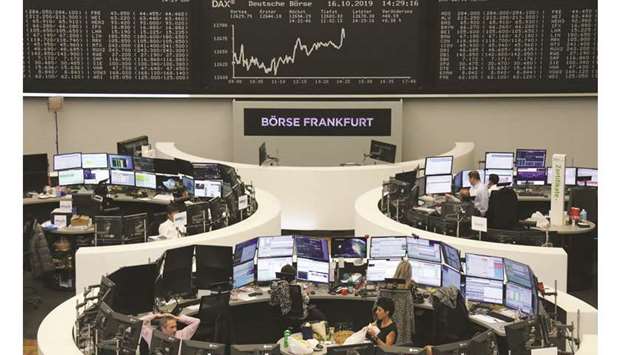
The German share price index DAX graph is seen at the Frankfurt Stock Exchange. The DAX 30 rose 0.3% to 12,670.11 points yesterday.