


The Qatar Transportation and Traffic Safety Centre (QTTSC) at Qatar University College of Engineering (QU-CENG), in collaboration with the International Road Federation, has hosted a training workshop on ‘Traffic Safety in Work Zones’ recently.
This came as part of the continuous efforts made to implement the National Traffic Safety Action Plan (2018-2022), QU said in a statement.
The workshop aimed to provide information on best procedures and practices in designing work zones along roads to ensure safe and efficient traffic operations.
The course discussed the requirements for planning work zone areas following the Qatar Work Zone Traffic Management Guide and other well-known international guidelines.
Common safety problems and challenges in work zone areas were presented at the training with real-world examples.
In addition, a site visit was conducted to provide participants with real-world observation on both good and unfavourable practices in work zone management.
Senior engineers from the General Directorate of Traffic, Ministry of Municipality and Environment as well as many other engineering consultation companies and contractors participated in the workshop.
Miguel Santos, a senior road safety specialist in the United Nations for Project Services, delivered the workshop, which was co-sponsored by Khatib & Alami Engineering Consultation Company as part of their commitment to support the efforts for improving traffic safety in Qatar.
QTTSC director Prof Dr Faris Tarlochan said: “Traffic safety in work zones is a critical issue in Qatar; therefore, QTTSC is working actively to contribute to improving the traffic safety status in collaboration with local authorities and international partners. This workshop is one of a number of forums that address best engineering practices in road safety, in line with the efforts by the centre and the College of Engineering to raise public awareness and responsibility in road safety.”
QTTSC workshop co-ordinator assistant professor Dr Wael Alhajyaseen said that with the vast development and upgrade of the road network in Qatar, work zones become common and frequent.
Work zones are crash-prone areas due to the unexpected change in road layout and environment.
The careful layout of these areas and the consideration of local site conditions and driver behaviour is vital for the success in providing efficient and safe operations.
The course offered different policies and strategies to provide safer design of work zones following current local and international guidelines not only for vehicular traffic but also for vulnerable road users.
He added, “This training course targets road agency executives, highway engineers, traffic management professionals, traffic safety professionals, vulnerable road users safety advocates, the law-enforcement authority and research and academia personnel.”
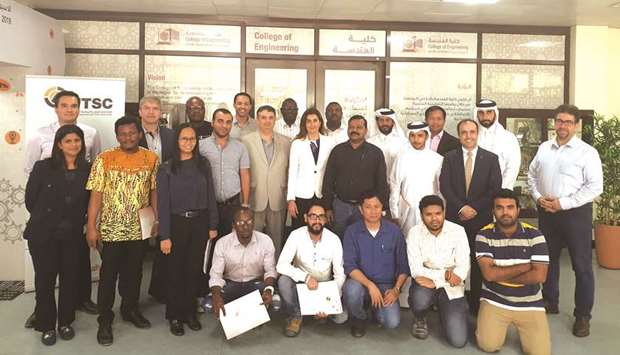
A group photo of the participants.