


Asian markets sank yesterday following a worse-than-expected reading of US factory activity that revived worries about the impact of the trade war on the global economy.
Adding to the selling pressure in Hong Kong were long-running concerns about the impact of increasingly violent pro-democracy protests in the city that saw a demonstrator shot and wounded by police on Tuesday.
Regional investors took their lead from Wall Street, where equities tanked in response to news that an index of US manufacturing activity fell last month to its lowest point since June 2009.
The data pointed to the impact of the China-US trade war on the world’s top economy and will likely put pressure on Donald Trump to push through an agreement.
Top-level talks are planned for this month. Manufacturing is “thought to be the specific chunk of the economy the president must...protect and the sector the US aggressive trade policies were supposed to enhance”, said Stephen Innes, Asia-Pacific market analyst at AxiTrader.
“So, the data could also imply not only monetary policy infusion is on the way but could increase the odds of some type of trade war detente.”
The figures combined with a weak eurozone inflation reading and a contraction in Britain’s economy in the second quarter.
Tokyo ended 0.5% lower, Sydney fell 1.5% and Singapore lost 1.2%, with Manila also off more than 1%.
Taipei, Wellington, Bangkok and Jakarta were also lower. Seoul shed almost 2% after North Korea fired a missile into the sea just a day after Pyongyang said it would resume stalled nuclear talks this week.
“Looking at the broader picture, it is fair to say that the worldwide manufacturing sector is in trouble,” said David Madden, market analyst at CMC Markets. “The US-China trade spat is having a knock-on effect around the globe.” Hong Kong fell 0.2% — though it pared earlier steep losses — as investors returned from a public holiday to mark China’s National Day but which saw some of the worst violence in the city since protests began in June.
A teenager was shot in the chest by a policeman, fuelling fears of a worsening of the unrest that has crippled the city’s economy.
Shanghai was closed for a holiday.
On currency markets the dollar inched back after dropping Tuesday following the US factory data, which led to speculation the Federal Reserve will cut interest rates again this month.
It pushed on against the pound as Prime Minister Boris Johnson prepares to submit his final offer for a new Brexit deal later in the day, warning that if the EU turns it down Britain would leave the bloc this month with no divorce deal.
Dealers are also awaiting the release Friday of US jobs data, which could give an idea about the Fed’s rate plans, while the corporate earning season is also about to get underway.
“For the month of October I think we are going to continue to see there is no shortage of headwinds for what is going on in the environment in terms of risk to economic growth and global growth,” Terri Spath, chief investment officer at Sierra Investment Management, told Bloomberg TV.”There will be a lot more attention paid to that.”
In early European trade London, Paris and Frankfurt all fell more than 1%.
In Tokyo, the Nikkei 225 closed down 0.5% to 21,778.61 points and Hong Kong — Hang Seng ended down 0.2% to 26,042.69 points yesterday. Shanghai was closed for a public holiday.
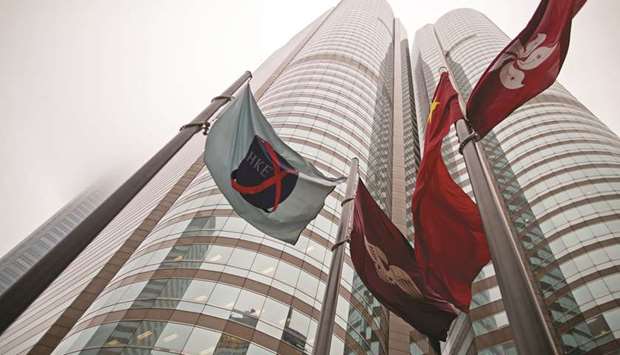
An external view of the Hong Kong Stock Exchange buildings. The Hang Seng closed down 0.2% to 26,042.69 points yesterday.