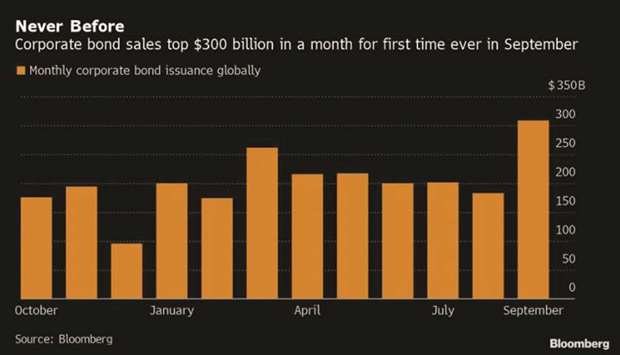
Companies globally sold a record amount of bonds in September as investors hungry for yield poured into debt, betting that major central banks can keep the global economy out of a recession and the worst can be avoided in the US-China trade war.
Firms from Apple Inc to France’s Orange and Japan’s SoftBank Group Corp sold more than $308bn of notes, the first time ever that corporate issuance has topped the $300bn mark in a month, according to data compiled by Bloomberg. Sales globally this year are on track to exceed the equivalent of $2tn at the fastest pace ever.
The onslaught of investment-grade deals in the US may ease to about $200bn in the last quarter as tight spreads potentially make investors more cautious and they position for 2020, JPMorgan Chase & Co said. Pacific Investment Management Co said last month that it is “cautious” on corporate credit, and favours short-dated names and those that are less likely to default.
“To the extent that new issuance is credit enhancing – refinancing and or extending the maturities of its debt – then the issuance is good for the companies as well the current bondholders,” said Todd Schubert, head of fixed-income research at Bank of Singapore Ltd. “Many of the issues that I have seen fall under this category.”
In Europe, corporate bond sales have already set a full-year record with three months still left to go. Annual investment-grade euro bond issuance will reach at least €580bn ($631bn), beating full-year totals dating back to at least 2014, Bloomberg data show. The tally includes €94.5bn of September deals, well above a previous €90.3bn record set in January.
US borrowers such as Medtronic Plc and Thermo Fisher Scientific Inc have sold a market-leading €68bn of bonds this year, partly to refinance costlier dollar debt. That tally is set to go even higher, with computer maker Dell Technologies Inc meeting investors from today for a planned debut sale of euro bonds, according to a person with knowledge of the matter, who declined to be identified citing company policy.
“€50bn-plus is easily achievable in the final quarter, even if the markets generally start to wobble in the face of macro and/or geopolitical event risk,“ said Suki Mann, founder of Creditmarketdaily.com, in a note to clients.