


Japan’s economy risks being derailed for a third time by a sales tax hike this week if shoppers like 63-year-old Kuriko Iwaki suddenly close their wallets.
Iwaki bought a rice-milling machine for around $55 ahead of the tax increase and stocked up on other household items. “Shampoo and all these other things will go up in price, so it may sound a bit strange, but I ended up buying enough garbage bags and other daily items to last me around three months,” she said in central Tokyo.
After postponing the tax hike twice already, Prime Minister Shinzo Abe is going ahead with it to show Japan is serious about chipping away at the developed world’s largest public debt load, and to keep up with spiralling social security costs as the population ages.
Aware of the risks, Abe’s administration has bent over backwards to avoid the same economic whiplash Japan experienced in 2014 – the last time the levy was pushed higher. A raft of counter measures has been designed to smooth out the boom and bust in consumption – by some calculations they add up to more than the extra proceeds from the tax increase in its first year.
In Bank of Japan governor Haruhiko Kuroda, a former finance ministry official, Abe has an ally who may also be poised to do his bit to ensure the hit to growth is temporary. In the fourth quarter, economists see the largest contraction since the levy was last raised in 2014, with a rebound to follow in 2020.
But in the near term, the push to tighten fiscal policy with the increase to 10% from 8% today adds more pressure on Kuroda to deliver even more monetary stimulus.
The world’s third-largest economy has had a torrid time trying to lift its sales tax before. In 1997, a hike to 5% from 3% contributed to three quarterly contractions in less than a year and a half, and an election defeat that cost the job of then Prime Minister Ryutaro Hashimoto. In 2014, just as Kuroda’s massive stimulus program was gaining traction on inflation, an increase in the tax to 8% pulled the rug underneath consumption and prices, shrank the economy by more than 7% and forced the BoJ to expand its stimulus.
This time, the hike comes as US-China trade tensions amplify a global slowdown that has prompted the BoJ to assess whether it needs to do more to support the economy and prices at its next meeting on October 30-31.
“The BoJ is well aware of the danger of the sales tax hike taking place just as they fret about the risks from the global economy,” said Yoshimasa Maruyama, chief market economist at SMBC Nikko Securities. “That’s why they’re putting out signals hinting at additional stimulus next month and the chances are high that they will act, even if they really wish they didn’t have to.”
The central bank has signalled loud and clear its concern over the increase. Since July last year it has flagged the need to monitor the potential economic hit from the hike in its promise to keep interest rates extremely low for an extended period.
Analysts surveyed by Bloomberg currently predict the economy to shrink by an annualized 2.7% in the last three months of 2019. But the spread of forecasts is wide. While Japan’s service sector has helped the economy show surprising strength so far this year, outweighing the impact of slumping global demand for the country’s manufactured goods, a slide in consumption after the tax hike could transform that equation.
This time, the signs are better that the economy may show resilience after the sales levy goes up. Even still, some economists suspect the BoJ will prefer to be seen doing something – possibly in tandem with Abe’s government – to ensure the economy and the goal of goosing inflation stay on track.
Success in finding a formula to smoothly raise the unpopular tax would end up among Abe’s biggest economic achievements, after reflating the economy and restoring moderate growth.
The BoJ said in its July Outlook report that it expected front-loaded demand to be “marginal” this time round compared with 2014, though it still expects housing investment and private consumption to fall for some time after the tax hike.
Tax breaks on buying cars and property have limited front-loaded demand for big-ticket items. The prospect of tax-back points on cashless purchases after the hike are also giving consumers pause for thought. Looser restrictions on cut-price sales after October 1 also present the possibility of bargain-buying after the hike as retailers try to keep demand steady.
Preliminary data for September show signs of a spike in home appliance and furniture buying, but not a mad rush to splurge. Spending on household appliances and goods rocketed 83% in March 2014, the month before the last hike, but early sales figures at some major retailers are generally not as strong as five years ago.
Sales at department stores are up between 4-5% so far in September from a year earlier compared with a 25% jump in March 2014, according to the Japan Department Store Association.
Televisions, fridges, air conditioners and washing machines are selling at around twice the pace of a year ago so far in September, according to early figures from Bic Camera Inc, an operator of about 40 electrical appliance stores nationwide.
At this pace, the increase in overall sales could match the 53% jump of March 2014, said Bic Camera PR official Tetsuya Yamazaki. He cautions that September, unlike March, isn’t usually a big month for selling appliances, so he doubts total sales in the month before the hike will reach the level seen last time.
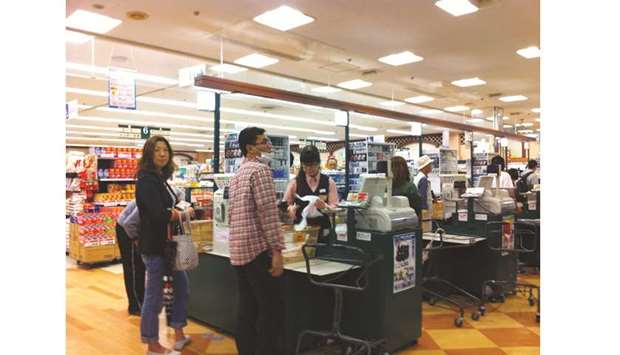
Shoppers at a supermarket in Tokyo. After postponing the sales tax hike twice already, Prime Minister Shinzo Abe is going ahead with it to show Japan is serious about chipping away at the developed world’s largest public debt load, and to keep up with spiralling social security costs as the population ages.