


Thomas Cook Group Plc’s grounded planes ruined thousands of holidays. They’re also likely to disappoint creditors waiting to get some of their money back after liquidators sorting through the company’s wreckage sell them off.
The travel group’s compulsory liquidation this week put it under the control of a government-appointed receiver and consultants AlixPartners and KPMG. They’re responsible for stripping the company down into sellable parts in order to return as much cash as possible to creditors.
There won’t be much though. An analysis by AlixPartners in August estimated bondholders could get as little as 2% of their money. The assessment was less gloomy for lenders, who may enjoy a recovery rate of almost 17%. But even that assumes the receiver can sell Thomas Cook’s assets at a decent price, which may be difficult.
S&P Global Ratings on Tuesday put the recovery value as high as 10% on the group’s unsecured bonds but warned investors could also get nothing. Creditors will be competing with other claims on funds including aircraft financing contracts and pension obligations, according to the ratings firm.
At the time of Thomas Cook’s liquidation in the early hours of Monday, the travel agent was operating almost 120 planes and held more than 1,500 weekly airport slots in Britain, Germany and Scandinavia.
But most of Thomas Cook’s planes are leased from other companies. AlixPartners said Thomas Cook and its subsidiaries, some of which are still operating, owned just 22 aircraft, but those are mostly old and may not fetch much of a price, according to Neill Keaney, a senior analyst at CreditSights. Based on data from aviation consultancy Cirium, Thomas Cook’s aircraft “will probably yield less than £100mn.”
Landing rights could be another source of cash. S&P says it’s hard to assess their value, but liquidators could auction some of Thomas Cook’s 208 weekly peak-season slots at London’s crowded Gatwick Airport, among the most sought-after in Europe.
UK carrier Monarch Airlines won the right to exchange landing permits in the wake of its own 2017 collapse after winning a court case. Selling airport slots may not be possible in locations where landing rights revert back to the aviation authority when an airline ceases to operate.
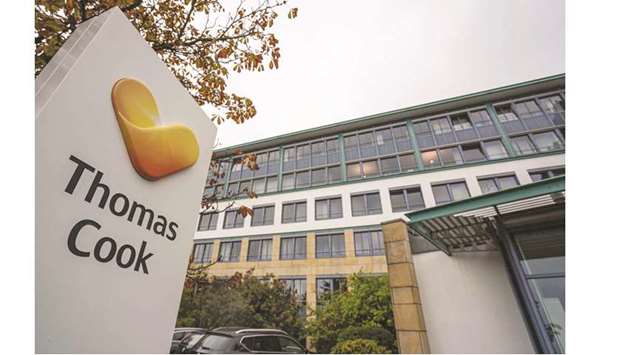
The company logo is pictured in front of the headquarters of the German arm of bankrupt British tour operator Thomas Cook in Oberursel near Frankfurt, western Germany on Wednesday. S&P Global Ratings on Tuesday put the recovery value as high as 10% on the group’s unsecured bonds but warned investors could also get nothing.