


Prime Minister Narendra Modi on Tuesday brushed aside an outcry from human rights activists to receive an award from the Gates Foundation in New York for his efforts to end open defecation.
The decision to honour the Indian leader provoked several withering op-eds and the ire of three Nobel prize winners, citing rising attacks against minorities under Modi’s tenure, while British-Asian actors Jameela Jamil and Riz Ahmed who had been due to attend dropped out.
The Bill and Melinda Gates Foundation said it respected the critics’ views but defended its decision, saying sanitation is a neglected issue and India’s programme can serve as a model for other countries.
“I dedicate this award to all those Indians who transformed the ‘Clean India Mission’ into a people’s movement and started giving cleanliness the highest priority in their daily lives,” Modi said after collecting the award from billionaire philanthropist and Microsoft founder Bill Gates.
India’s government says it has built more than 100mn toilets under a $20bn initiative begun in 2014 to address the issue of open defecation, particularly in rural areas, a major public health issue in the country.
Under Modi’s plan, tribal households get $200 each for building latrines.
But ahead of the ceremony, Nobel Peace Prize winners Mairead Maguire, Tawakkol Abdel-Salam Karman and Shirin Ebadi said that under Modi’s leadership, “India has descended into dangerous and deadly chaos that has consistently undermined human rights, democracy.”
“This is particularly troubling to us as the stated mission of your foundation is to preserve life and fight inequity,” they wrote, urging the Gates Foundation to change its decision.
In addition to a rise in mob lynchings of Muslims, Christians, and Dalits, they noted the decision by Genocide Watch to issue warnings for the state of Assam and Jammu and Kashmir.
Kashmir is under a communications blackout that has lasted 50 days after Modi rescinded its autonomy.
The award was also protested in an online petition that garnered 100,000 signatures as well as a comment piece co-authored by feminist leader Gloria Steinem.
Hours before Modi received the award, a staff member at the Gates Foundation reportedly resigned in protest.
Sabah Hamid, a 42-year-old communications specialist, said that honouring Modi while he imposed a communications and movement lockdown on Kashmir was a grave error.
“Since the foundation seemed set on its course of action to go ahead with the award – which as a private foundation it is entitled to – I could do just one thing: leave,” Hamid said.
The former employee said she took up the matter with her superiors, but “realised very quickly that this was a decision that would not be changed”.
Hamid, a Kashmiri, has been with the Gates Foundation for over three years.
“Being Kashmiri makes it personal. Eight million of my people have been under an undeclared curfew for 50 days now, with minimal access even to medical care, and there is a humanitarian crisis under way in the (Kashmir) valley. The Modi-led government has not only designed and implemented this crisis, their untruths and the complicity of a large part of the media means they are also trying to hijack the narrative. Being feted at large international gatherings, and winning awards plays right into that,” she said.
Modi won a second term in a huge election victory in May and drew tens of thousands of diaspora fans on Sunday in an unusual joint rally in Houston with President Donald Trump.
He did not respond to the criticism over the award.
The Gates Foundation said in a statement: “Before the Swachh Bharat mission, over 500mn people in India did not have access to safe sanitation, and now, the majority do.
“The Swachh Bharat Mission can serve as a model for other countries around the world that urgently need to improve access to sanitation for the world’s poorest.”
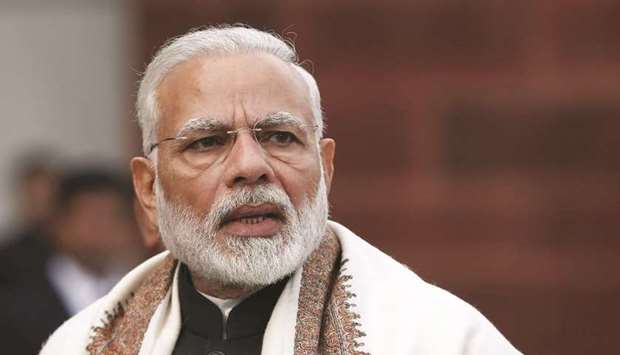
Indian Prime Minister Narendra Modi