


Tunisia set up a crisis cell to deal with the fallout of British tour operator Thomas Cook’s collapse yesterday, which has left around 4,500 mostly British tourists stranded in the North African country, officials said.
Tunisian authorities said officials and tourism industry representatives from both countries were to meet today with Tunisia’s central bank.
Thomas Cook, which had suspended trips to Tunisia after the deadly militant attacks in 2015, returned in force last year and in 2019 with around 100,000 bookings a year, mostly from Britons.
“We currently have about 4,500 British tourists in the hotels who will finish their stay as scheduled, and their repatriation will be paid for by London,” Tourism Minister Rene Trabelsi said on Mosaique FM radio.
Managers of a hotel in the coastal resort of Hammamet briefly delayed the departure of a group of tourists until they could verify that payments owed by Thomas Cook had been made, an interior ministry spokesman told AFP.
The resort managers requested additional payments even though the group had already paid the costs of their stay in full, one tourist said.
“After an hour they left the hotel and are currently at the airport,” said the government spokesman. “There are other Thomas Cook groups in Hammamet, Sousse, Mahdia and Djerba — all payment procedures have been settled.”
Thomas Cook owes Tunisian hotels €60mn ($66mn) for stays in July and August, Tourism Minister Trabelsi told Reuters yesterday, adding that 4,500 British Thomas Cook customers are still in the country. Tourism is a vital sector for Tunisia’s economy and a key source of foreign currency, and the government had expected another 50,000 Thomas Cook customers to visit this year, he added. “I will have a meeting on Tuesday with the British Embassy in Tunisia and the hotel owners to see how debt could be redeemed,” Trabelsi said.
The collapse of Thomas Cook, one of Britain’s oldest companies, has stranded more than half a million tourists around the world.
It ran hotels, resorts and airlines for 19mn people a year in 16 countries.
Britain’s Civil Aviation Authority (CAA) said the government had a fleet of planes ready to bring home British customers over the next two weeks and they should not go to the airport until they had been informed they were due on a return flight.
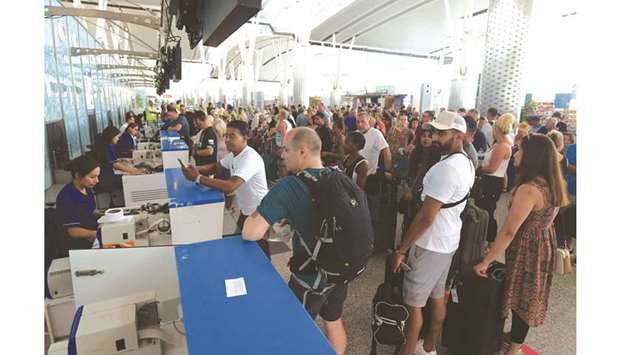
British tourists, flying with Thomas Cook, queue at the Enfidha International airport, on the outskirts of Sousse south of Tunis yesterday. Thomas Cook owes Tunisian hotels u20ac60mn for stays in July and August, Tourism Minister Rene Trabelsi told Reuters yesterday.