


India’s space programme suffered a huge setback yesterday after losing contact with an unmanned spacecraft moments before it was due to make a historic soft landing on the Moon.
But the mission has accomplished 90-95% its objectives, the Indian Space Research Organisation (ISRO) said.
In a statement, ISRO said: “The success criteria was defined for each and every phase of the mission and to date 90 to 95% of the mission objectives have been accomplished and will continue to contribute to lunar science, notwithstanding the loss of communication with the lander.”
Blasting off in July, India had hoped to become just the fourth country after the United States, Russia and China to make a successful Moon landing, and the first on the lunar South Pole.
But in the early hours of yesterday, as Prime Minister Narendra Modi looked on and millions watched nationwide with bated breath, the Vikram lander – named after the father of India’s space programme – went silent just 2.1km above the lunar surface.
Its descent had been going “as planned and normal performance was observed”, ISRO chairman K Sivan said.
“Subsequently the communication from the lander to the ground station was lost,” he said after initial applause turned to bewilderment at the operations room.
“The data is being analysed.”
The Chandrayaan-2 orbiter, which will circle and study the Moon remotely for a year, is however “healthy, intact, functioning normally and safely in the lunar orbit”, the ISRO said.
According to the space agency, the lander followed the planned descent trajectory from its orbit of 35km to just below 2km above the surface.
“All the systems and sensors of the lander functioned excellently until this point and proved many new technologies such as variable thrust propulsion technology used in the lander,” ISRO said.
The space agency said the precise launch and mission management has ensured a long life of almost seven years for the Chandrayaan-2 orbiter instead of the planned one year.
According to Sivan, the orbiter has sufficient amount of fuel onboard for it to operate for seven years.
The ISRO said Chandrayaan-2 was a highly complex mission, which represented a significant technological leap compared to its previous missions.
It brought together an orbiter, lander and rover to explore the unexplored south pole of the Moon.
As the mission control lost contact with the spacecraft, Modi sought to comfort glum scientists and a stunned nation, saying India was still “proud” and clasping the visibly emotional Sivan in a lengthy hug.
The prime minister had hoped to bask in the glory of a successful mission, but yesterday he deftly turned consoler-in-chief in a speech at mission control broadcast live on television and to his 50mn Twitter followers.
“Sisters and brothers of India, resilience and tenacity are central to India’s ethos. In our glorious history of thousands of years, we have faced moments that may have slowed us, but they have never crushed our spirit,” he said.
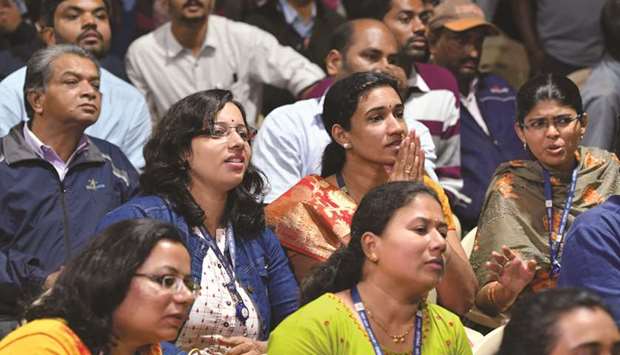
ISRO employees react as they watch the live broadcast of the soft landing of spacecraft Vikram lander early yesterday. India lost communication with the spacecraft just before it was due to land on the Moon.