


A cross-party alliance defeated Boris Johnson in parliament yesterday in a bid to prevent him taking Britain out of the EU without a divorce agreement — prompting the prime minister to announce that he would immediately push for a snap election.
Lawmakers voted by 328 to 301 for a motion put forward by opposition parties and rebel lawmakers in Johnson’s party — who had been warned they would be kicked out of the Conservative Party if they defied the government.
More than three years after the United Kingdom voted in a referendum to leave the European Union, the defeat leaves the course of Brexit unresolved, with possible outcomes still ranging from a turbulent ‘no-deal’ exit to abandoning the whole endeavour.
Yesterday’s victory is the first hurdle for lawmakers who, having succeeded in taking control of parliamentary business, will today seek to pass a law forcing Johnson to ask the EU to delay Brexit until Jan 31 unless he has a deal approved by parliament beforehand on the terms and manner of the exit.
The Conservative rebels who now face expulsion from the party included Nicholas Soames, the grandson of Britain’s World War Two leader Winston Churchill, and two former finance ministers — Philip Hammond and Kenneth Clarke.
“I don’t want an election, but if MPs vote tomorrow to stop negotiations and compel another pointless delay to Brexit, potentially for years, then that would be the only way to resolve this,” Johnson told parliament after the vote.
“I can confirm that we are tonight tabling a motion under the Fixed Term Parliament Act.”
In an historic showdown between prime minister and parliament, Johnson’s opponents said they wanted to prevent him playing Russian roulette with a country once touted as a confident pillar of Western economic and political stability.
They argue that nothing can justify the risk of a ‘no-deal’ Brexit that would cut economic ties overnight with Britain’s biggest export market and inevitably bring huge economic disruption.
Johnson cast the challenge as an attempt to force Britain to surrender to the EU just as he hopes to secure concessions on the terms of the divorce, helped by the threat to walk out without one.
Ahead of the vote, he said would never accept another delay to Brexit beyond Oct 31.
Johnson’s government will now seek to hold a vote yesterday to approve an early election, most likely to be held on Oct 14.
An election would pit the avowed Brexiteer against Labour leader Jeremy Corbyn, a veteran socialist.
In the eye of the Brexit maelstrom, though, it was unclear whether opposition parties would support such a move — which requires the support of two-thirds of the 650-seat House of Commons.
Corbyn has long demanded an election as the best way out of the crisis, but many of those seeking to prevent a ‘no-deal’ Brexit say Johnson could time the poll to ensure that parliament cannot prevent an Oct 31 departure — with or without a deal.
After the vote, Corbyn told Johnson that he must get the Brexit delay bill that will be discussed today passed before trying to call an election.
The 2016 Brexit referendum showed a United Kingdom divided about much more than the European Union, and has fuelled soul-searching about everything from secession and immigration to capitalism, empire and modern Britishness.
PM ‘approved parliament shutdown in mid-August’
Boris Johnson had secretly decided to suspend parliament nearly two weeks before asking the Queen, according to memos from Downing Street read out in court.
The court in Edinburgh heard the first memo was written by Nikki da Costa, the prime minister’s senior legal adviser, on August 15 and spelled out the plan to suspend parliament in the week beginning September 9.
Her memo was circulated to a very small circle of key figures in Downing Street, including Mark Sedwill, the Cabinet Secretary, Ed Lister, the prime minister’s chief of staff, and Dominic Cummings, Johnson’s controversial chief adviser.
In public Johnson was then refusing to confirm he planned to do so but he ticked the secret memo and said “yes”, before sending Da Costa a handwritten note the following day, where he criticised the convention where MPs return for several weeks of Commons business after the summer holidays before breaking again for conference season.
He told Da Costa the “whole September session (at Westminster) is a rigmarole introduced to show the public that MPs are earning their crust. I don’t see anything especially shocking about this prorogation.”
This exchange of memos came 12 days before privy counsellors designated by Johnson met the Queen at Balmoral to ask her to prorogue parliament, on the grounds he wanted to present a significant new legislative programme on October 14.
The documents, revealed in heavily redacted form for the first time at 10.55pm on Monday, were sent to the legal team acting for 75 MPs and peers who are challenging prorogation in the court of session in Edinburgh.
Aidan O’Neill QC, acting for the MPs and peers, said he only received an unredacted version of the documents on Tuesday morning.
He told Lord Doherty, the judge hearing the case, this proved Johnson was plotting to suspend parliament at the same time that his government’s lawyers had told the court in Edinburgh the question of prorogation was “hypothetical and academic” because no such decision had been taken.
The government had also refused to give the court any sworn affidavits setting out why prorogation was necessary and the prime minister had ignored O’Neill’s suggestion last week that he should provide one to the court.
Accusing Johnson of “incontinent mendacity”, O’Neill said the prime minister had shown an unwillingness to acknowledge and speak the truth. He said: “He has chosen not to be accountable to this court and seeks not to be accountable to parliament.”
David Johnston QC, acting for the government, apologised to the court for failing to produce the papers until the night before the hearing and admitted the government had breached the deadline for submitting them.
He said they were being produced in the spirit of transparency, to allow the court to understand the process behind the decision to seek prorogation.
Reading from a brief prepared by the government, Johnston insisted the legal action was academic because MPs were still being given time to sit and vote before exit day on October 31, and set their own agenda.
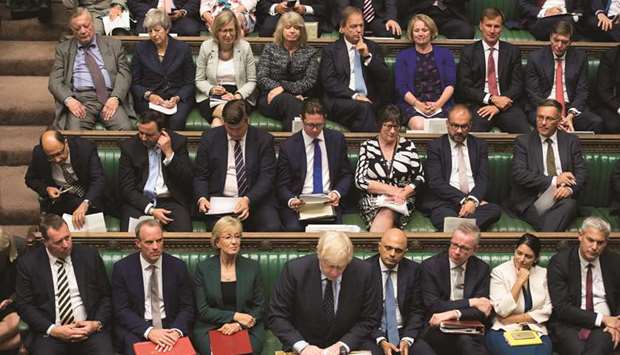
Britain’s Prime Minister Boris Johnson speaks at the House of Commons in London yesterday.