


Almost 30 years ago (1992) I was in Tokyo taking part in the Arab-Japanese dialogue committee sponsored by the Arab Thought Forum and the Japanese Ministry of Foreign Affairs. At that time the prevailing development thinking was about the Asian Miracle, the Asian Tigers Syndrome, the Coming Age of Asia, and the 21st century if it will be Asian. The West on its part was blessing, after the fall of the Berlin Wall, the birth of a unipolar new international order led by the USA. During the rounds of our meeting, I asked one of our Japanese counterparts if he believes that the global power shift to the East is possible and if Easternisation could compete with Westernisation in ruling the globalised world?
His answer was a clear no. World leadership, according to him, is a complex and intertwined process of international integration arising from the enforcement of a world view (liberal or otherwise), spread of products, ideas, and other aspects of culture. The world view, in his opinion, leans towards the Western culture. When people talk of ‘Westernisation’, they are referring to a whole range of things: modern values, liberty and freedom of expression, human-rights-based rule. Moreover reference is made to the consumer culture of Western capitalism with its now all-too-familiar icons (McDonalds, Coca-Cola, Levis Jeans, and Malboro, etc).
We in Asia, he continued, cannot easily commodify our culture and market it internationally, therefore one cannot talk about Eastrenisation competing with or replacing Westernisation. The economic hardware power we were able to developed, he goes, is not enough for us to lead the world, we need software power and that is cultural. We need to have stories to tell the world. Global leadership will come when our region has amassed enough soft power to weave an Asian narrative that commands respect. The currency of soft power is culture, political values, and foreign policies.
In this article I want to re-address the question after almost three decades and dive deep, trying to understand how Asia, with the emergence of China and India in the new millennium as world-class economic powerhouses, is about to reoccupy the centre of the global economic stage? Historically, this is happening at a time that the world is witnessing the relinquishing of liberal values and the disintegration of the liberal world order. Also, it is taking place where the world leadership became a vacant post. Does Asia in this cross section of history has a story to tell the world and pave the way to Easternisation?
As we all know, the world has got used these days to hearing “America First”— but is it ready for “Asia First”? What happens when Asia no longer just produces for the West but the West produces for Asia? And when Asians don’t aspire to live like the West but rather Western societies wish they had Asians’ stability and far-sighted leadership? Are we ready to see the world, and the future, from the Asian point-of-view? Are we going to see a fierce competition between Westernisation and Easternisation?
Listening to speeches of Modi of India and Xi of China, one can see that right now there is an emerging sense in Asia of a historical balance being readjusted, and that creates all sorts of questions, both about the West’s rather rosy view of its own role in world history and about the durability of the West’s period of dominance. I think those questions are perhaps now being asked, but they weren’t asked three decades ago when we met with the Japanese scholars and decision-makers in Tokyo.
The Asians, in my opinion, have come to realise that history is reaching full circle. As they see things, Asia’s recent sweeping surge represents for them a return to a historical norm. Asia dominated the world economy for most of human history until the 19th century. Around the end of the 17th century, Europe was looking with admiration and envy at a region of the globe which concentrated more than two-thirds of the world’s gross domestic product, and three-quarters of the world’s population. The industrial revolution in the West and the renaissance move made the tilt. Asia was transformed from the world’s manufacturing centre into classic underdeveloped economies exporting agricultural commodities.
But after World War II that trend has been gradually reversing. The dramatic rise of Japan and South Korea, the first countries in Asia to catch up with the West, has been steadfasted by China’s take-off following the country’s introduction of market-oriented reforms under Chinese leader Deng Xiaoping in the late 1970s. In just a couple of generations, a winning mix of integration with the global economy via trade and foreign direct investment, high savings rates, large investments in human and physical capital, and sound macroeconomic policies contributed to Asia’s economic leap forward, according to the IMF’s regional outlooks.
The world’s imminent entry to an Asian age is coming not just because of its largest economies, but also thanks to growth among smaller and midsize countries. Indonesia is on track to become the world’s seventh-largest economy at Purchase Power Parity (PPP) by 2020, and will have overtaken Russia by 2023 as the sixth biggest. Vietnam, one of Asia’s fastest-growing economies, has overtaken 17 countries in a ranking of economies in PPP terms since 2000, including Belgium and Switzerland. The Philippines is now a larger economy than the Netherlands while Bangladesh has overtaken 13 other economies in the past 20 years.
By 2030, Asia’s economy is estimated to be larger than that of the United States and the European Union combined. Asia is the world’s largest and most populous continent, comprising more than 4.2bn people (60% of the world population) living in 46 different countries or territories. It is the fastest-growing economic region.
“The west’s two-century epoch as global powerhouse is at an end,” argues Kishore Mahbubani in his latest book Has the West Lost It? Over the past five decades, hundreds of millions of people in Asia have been lifted out of poverty and many Asian economies have graduated to middle-income or advanced economic status, according to World Bank definitions.
“The future is Asian,” claims the geopolitical strategist Parag Khanna. In his new book with the same title, he argues that we are witnessing a tectonic shift in global power. If the 19th century belonged to Europe, and the 20th century to the United States, then the 21st century now belongs to Asia.
Seemingly, the Anglo-American narrative of history explained things wrongly. They told us that industrialisation and capitalism led to more mass democracy which then led to globalisation, internationalism, and multilateralism. They went far enough to claim at one time that this is a way of no return or the End of History.
Asia’s rise seems to challenge this narrative. Japan and South Korea developed in different ways from the West. China, under the single rule of the Communist Party and its political system of socialism with Chinese characteristics, obviously defeats the Western discourse. I think India does to some extent as well. The question is: What might has the West missed in trying to apply a history based on Western experiences to that part of the world?
To the extent that they did notice it in the 1990s, they told themselves a story derived from what had just happened in Eastern Europe about how economic development was linked to democracy. Maybe in the first stage countries could grow very fast without a democratic system, but in the long run a sophisticated modern economy would have to become democratic. For them the Chinese are marching in the road towards capitalism and, therefore, the West could relax about the rise of China because it has no other alternative but to choose economic development and democracy and therefore would lead to a kind of convergence. This meant that the rise of China would not be a threat to Westernisation.
I think the West has missed a couple of things. When Chinese political figures speak about the market-led world order and capitalism or rule-based multilateralism, they are speaking about the world they want to see, not the liberal world that exists today. Unsurprisingly, the world they want is one in which they have a greater share of power than they have now.
China and other Asian countries’ view of their own history would to some extent inevitably place them at odds with the established powers in the West , because their interpretation of history is they were exploited by the West. China has its “Century of Humiliation”. Even the Indians, who are still in a democratic system, are very conscious of colonialism and imperialism.
The form that Asia’s soft-power story required for marketing the world view of Eastrenisation will remain a work in progress for the emerging multi-polar international order: The Belt and Road Initiative (BRI) as a global infrastructure development strategy and investments in 152 countries and in Asia, Europe, Africa, the Middle East, and the Americas will not be only bricks and mortar. Asia’s intellectuals still need to forge that vision. They have to tell the world that Euro-centric societal vision of Modernity and Modernisation could be matched by Confucianism and Buddhism which embraces modern values and principles. In some sociological writings Confucianism and Buddhism have been considered the ‘Protestant ethic’ of the East. They are secular, because they are not monotheistic religions, and they are characterised by bureaucratisation, which means they are rational systems in nation building. In all traditional Confucian countries, the selection for the national bureaucracy is strictly based on merit. This is the essence of modernisation theory. As Max Weber pointed out, bureaucratisation and selection by achievement instead of on a hereditary basis (as in traditional societies) are characteristics of modern, rational societies.
Buddha holds that though people’s beliefs about values may change over time, there are certain values which have universal validity. There is a system of core values which can be discovered by human intelligence and experience, and these have to be upheld at all times if human beings are to lead a decent form of life.
In fact all these Eastrenisation values which are based on Collectivism find social acceptability and resemblance in majority of societies worldwide compared to individualism that prevails in the Euro-centric West.
All these modernisation views can constitute the soft power required to weave an Asian narrative that commands respect worldwide. They sit easily with and, indeed, are on ample offer in Asia.
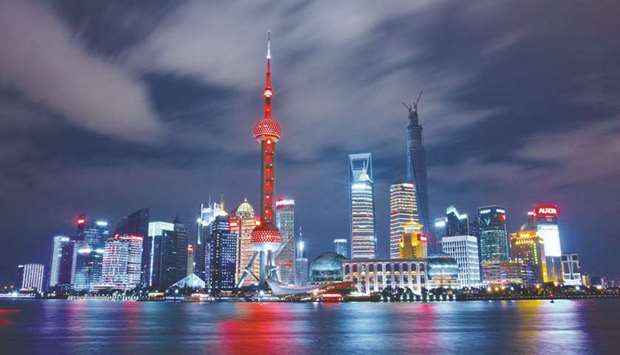
China’s emergence in the new millennium as world-class economic powerhouse is about to reoccupy the centre of the global economic stage. Via https://www.goodfreephotos.com/