
The pound fell versus the dollar and euro yesterday as Britain’s government moved to extend the suspension of parliament, increasing the likelihood of a no-deal Brexit.
Britain’s currency slid by more than 1% against both currencies in early business, before paring the loss to nearer 0.6% — still down some 3.7% over three months.
“The pace of sterling’s drop demonstrates yet again the currency’s susceptibility to Brexit fears,” said Han Tan, market analyst at FXTM trading group.
The pound’s plunge helped London’s benchmark FTSE 100 index outperform as it features many multinationals with most of their earnings in dollars — whereas construction companies notably saw their shares take a tumble.
Across Europe, London’s FTSE 100 gained 0.4% to close at 7,114.71; Frankfurt’s DAX 30 was down 0.3% at 11,701.02, while Paris’ CAC 40 lost 0.3% at 5,368.80.
British Prime Minister Boris Johnson yesterday announced that the annual suspension of parliament would be extended until October 14 — just two weeks before the UK is set to leave the European Union.
“Such an event would curtail attempts to block a no-deal Brexit within the UK parliament,” Tan added.
Anti-Brexit MPs said Johnson’s move amounted to a coup and a declaration of war, branding the prime minister a dictator.
The extension “certainly caught markets off-guard and came at a time when the pound had been recouping some of its (previous Brexit-fuelled) losses”, noted Craig Erlam, senior market analyst at Oanda.
Fiona Cincotta at Cityindex said there was still more downside for sterling.
“Any bad news from Brussels regarding Irish backstop alternatives as talks kick off over there could send the pound tanking back towards the key psychological support of $1.20,” she said.
Although the Dow Jones was in positive territory mid-session, eurozone stock markets lost ground on a stronger euro, and uncertainty over China-US trade talks that weighed also on Asian equities.
A poll yesterday showed German consumer sentiment is stabilising after three months of decline and despite fears of a looming recession in Europe’s biggest economy.
Pollsters GfK said their forward-looking consumer barometer stood at 9.7 points, unchanged from August when it had fallen to its April 2017 level.
In commodities trading, oil prices extended Tuesday’s surge that came in response to figures showing US stockpiles dived more than 11mn barrels last week, lifting hopes for demand and offsetting worries about the impact of a trade war.
Also providing support was Iranian President Hassan Rouhani’s call for the United States to lift all sanctions against his country before he would meet Trump, after the US leader had said he would be open to talks.
The Islamic republic’s foreign minister has said the chances of a face-to-face were “unimaginable”, meaning there was little chance of a thawing of tensions that would see the return of Iranian oil onto markets.
In government bond markets, Italian bond yields fell below 1%, their lowest level ever, on hopes that a new government can be formed without fresh elections.
Business / Business
Pound dives on increased no-deal Brexit prospect amid extension of suspension of parliament


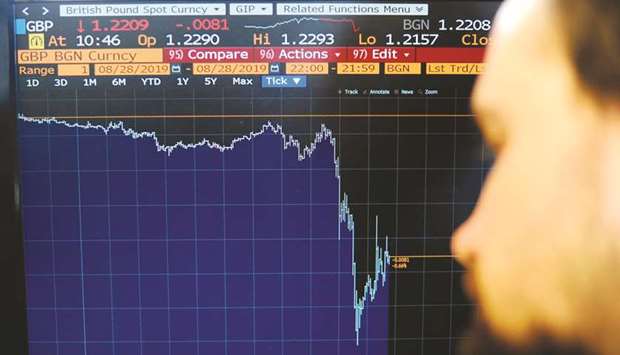
A journalist poses while looking at a computer screen with the Bloomberg display showing the movement of the value of the pound sterling against the US dollar in London yesterday. The pound slumped almost 1% versus the dollar and euro on reports that Britain will seek to extend the suspension of parliament, making a no-deal Brexit more likely.