


Anger was mounting in Jammu and Kashmir against the government’s decision to revoke the special status of the Muslim-majority state, residents and officials said, although authorities eased some curbs to allow people to offer Friday prayers.
Seeking to tighten its grip on the state, India this week scrapped the state’s right to frame its own laws and allowed non-residents to buy property there.
Since Sunday telecoms links have been suspended, at least 300 leaders detained and public gatherings banned, effectively confining residents to their homes.
Television images showed dozens of people walking on the streets of Srinagar for the first time this week to offer prayers at mosques guarded by police.
“Every time we have embraced India, they have cut our throats,” read a handwritten poster at one mosque, which also urged Kashmiris not to sell land and to hold protests after Eid prayers on Monday.
Leaders in Kashmir had warned that scrapping the special status would be seen as an act of aggression against the people of the state, where more than 50,000 people have died in a 30-year revolt against Indian rule.
There have been no major protests, barring sporadic instances of stone-throwing in the last few days, but several residents and a police official told Reuters resentment against the decision was building.
“There is a lull right now... the situation can go out of control,” said the police official, who declined to be named as he was not authorised to speak to the media.
Policemen in riot gear were posted every few metres around the Jama Masjid mosque in Srinagar’s old quarter.
One officer said he faced regular attack from young people throwing stones.
In New Delhi, however, foreign ministry spokesman Raveesh Kumar told a news briefing that Kashmir was calm and the inconvenience expressed by its people was “very temporary”.
Separately, he told Reuters, “Just outside Srinagar things have really come back to normal.”
Kumar added, “People are going about their business, vehicles are plying normally. If we are confident of maintaining the law and order, I think those restrictions will be relaxed, I’m quite sure.”
National Security Adviser Ajit Doval met the governor of Jammu and Kashmir and “expressed satisfaction regarding the overall situation, which is, by and large, peaceful,” the state government said in a statement.
Time for Pakistan to accept reality: India
India yesterday said it was time for Pakistan to accept the new reality on Kashmir and urged Islamabad to review its unilateral decision to snap ties.
Ministry of External Affairs spokesman Raveesh Kumar said: “It is time for Pakistan to accept the reality (of scrapping of Article 370) and stop interfering in the internal affairs of another country.” He said Pakistan is upset over the revocation of special status for Kashmir and the massive development work that is planned to be brought into the state now as Islamabad “will not be able to mislead the people of Kashmir anymore”.
He stressed that “all matters relating to J&K are an internal matter, and a sovereign matter concerning India. We want Pakistan to understand this.”
He said Pakistan’s attempt to present a picture of an alarming situation in Kashmir and linking it to what is a sovereign matter of India “has not succeeded anywhere”.
Referring to Pakistan expelling the India’s high commissioner and snapping trade ties among other measures, he said: “We hope they review the decision, and hope they address the core issues.” Asked what Pakistan would have meant by announcing that it will review all bilateral arrangements, he said since the steps announced were unilateral “we don’t know”.
Kumar said the ministry as well as External Affairs Minister S Jaishankar have briefed a number of foreign governments and multilateral organisations about India’s steps on Kashmir, and conveyed to them that “they constitute a sovereign jurisdiction, and relates to our internal affairs”.
To a question on Pakistan planning to internationalise the Kashmir issue, he said: “When Pakistan decides to internationalise it, we will decide what is to be done.”
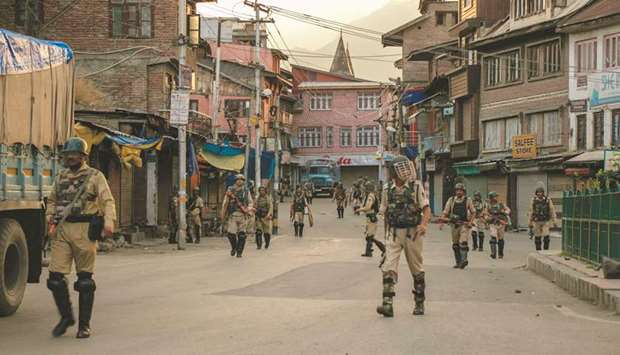
Security personnel walk on a street in Srinagar yesterday as widespread restrictions on movement and a telecommunications blackout remained in place after the government stripped Jammu and Kashmir of its autonomy.