


Security implications following the government’s decision yesterday to scrap special status to Jammu and Kashmir would depend on the reaction of locals, military experts said.
The government also moved a bill to bifurcate the state into two union territories – Jammu and Kashmir with an assembly and Ladakh without one.
According to the experts, the external security in the region will depend on the way Pakistan and China react to the decision.
Kashmir is cut off from the rest of the country at present with all communication lines snapped. Top Kashmir political leaders are placed under house arrest.
“Right now the security arrangement in the valley is huge and it depends on how the locals react to it in the long term. At present, Pakistan is too involved in its problems with Afghanistan and the Taliban. Once it’s able to settle them, it could turn attention towards India,” former navy chief Admiral Arun Prakash told IANS.
“China won’t involve itself directly in the Kashmir issue. But overall security in the area also depends on what kind of support it extends to Pakistan.”
Lieutenant General (retd) Deependra Singh Hooda, former GoC-in-C of the Northern Command, told IANS India was well prepared to deal with any kind of breakdown in law and order.
The government had deployed a huge contingent of central forces in the valley anticipating violence, ahead of its decision to announce the presidential order on withdrawing special status to the state, he said.
“There is a feeling that the law and order problem could intensify in the valley. But with the induction of additional police forces, we are better prepared to deal with contingencies,” Hooda said.
Some legal experts said the move will give more room to the central government to control the valley.
Describing how union territories with an assembly function, the experts said two union territories of Jammu and Kashmir will get the benefit of a partial state such as Delhi and operate somewhat differently from Ladakh, a proposed union territory without a legislature.
Union territories are federal territories governed directly by the central government through its representatives.
Welcoming the decision, senior advocate Rakesh Dwivedi said now the government can govern the Valley directly through Lieutenant Governor as the administrator.
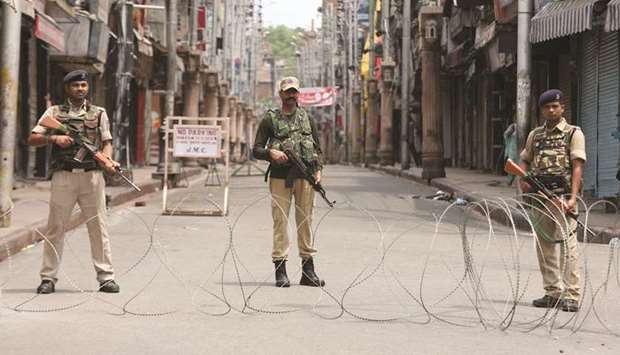
Security personnel stand guard along a deserted street during restrictions in Jammu yesterday.