


Brexit
will take place on October 31 “whatever the circumstances”, Downing
Street has said, refusing to say whether Boris Johnson would regard a
vote in parliament against a no-deal departure as sufficient reason to
change course.
Quizzed repeatedly at a media briefing, the prime
minister’s spokesman also declined to say whether the government would
consider allowing no-deal to happen if it were amid an election
campaign, or if Johnson lost a no-confidence vote in the Commons.
The
spokesman said he could not comment on hypothetical situations. But
asked whether, as a matter of broader principle, Johnson could commit to
respecting votes in parliament, he also declined to answer.
He
pointed out that a no-deal departure was simply the consequence of
legislation as it stood: “The legal default, as put in place by
parliament, is that the UK will leave on October 31, with or without a
deal.” The comments, which indicate a further ratcheting up of the new
government’s rhetoric on no-deal, began when the spokesman was asked
whether it now appeared to be too late for the UK to depart with a new
agreement.
Johnson currently has no Brexit talks scheduled with
European leaders, having set down the unilateral condition that the EU
must first ditch the backstop insurance clause for the Irish border,
something Brussels has long insisted is impossible.
The spokesman
said: “It is my job to set out the PM’s position, and that is that the
UK will be leaving the EU on October 31 whatever the circumstances.
There are no ifs or buts. We must restore trust in our democracy and
fulfil the repeated promises of parliament to the people by coming out
of the EU on October 31. Politicians cannot choose which votes to
respect. They promised to respect the referendum result. We must do so.”
In
a sometimes confusing series of exchanges with the media, Johnson’s
spokesman refused at least 10 times to outline whether this deadline
could be changed by the actions of MPs, saying he could not comment on
theoretical situations.
Asked if Johnson would respect a
no-confidence vote against his government were one passed, he said: “One
hasn’t been called, and one hasn’t been held, and I have never
discussed hypotheticals. The key point is we are leaving on October 31
whatever the circumstances.”
On the subject of whether Johnson would
abide by a vote in parliament to, for example, stop or delay Brexit,
the spokesman said: “My answer on this is not going to change, and none
of those things have happened.”
There was a similar response on the
notion of no-deal happening on October 31 even if this fell during a
general election campaign, a period when, by convention, the incumbent
government does not take any major decisions.
The spokesman similarly
declined to say whether a Johnson government had a general policy of
abiding by votes of parliament, saying: “What I’m doing is not engaging
in some hypothetical game you’re trying to pull me into.”
Having
repeatedly declined to comment, the spokesman then rejected the idea it
was fair to say the government was not ruling out ignoring the will of
parliament, saying: “No, it wouldn’t be a fair characterisation. This
conversation began with you putting forward hypothetical propositions,
and I have said, ask me the questions about those specific votes at the
time.”
The comments will nonetheless alarm opponents of a no-deal
Brexit who fear Johnson might try to force through such an outcome
against the wishes of MPs, for example by proroguing parliament, or by
delaying a general election until after the Brexit date.
Speaking on a
visit to the flood-threatened town of Whaley Bridge in Derbyshire,
Jeremy Corbyn said Johnson “seems to be trying to slip no-deal through,
slip past parliament and slip past the British people”.
The Labour
leader said no-deal “will be really serious – serious for food prices,
for medical supplies, for trade, for investment and drive us straight
into the hands of the sort of trade deal that Donald Trump wants to do
with Boris Johnson. I’m sorry, it’s not on, it’s not acceptable. We will
do everything we can to block it.”
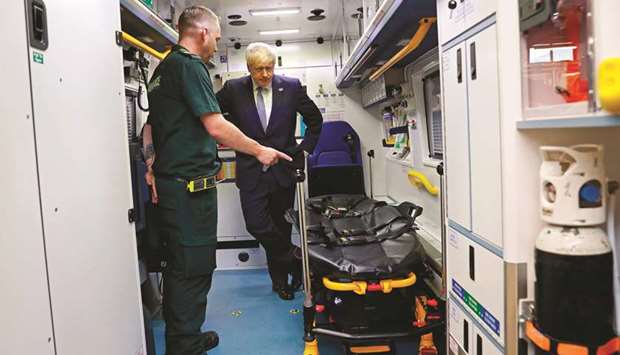
Prime Minister Boris Johnson inspects an ambulance during a visit to Pilgrim Hospital in Boston, eastern England, yesterday.