


New Prime Minister Boris Johnson held talks with allies in Northern Ireland yesterday in a bid to solve the Irish border conundrum that has scuppered all efforts to secure an orderly withdrawal from the European Union.
Sterling has fallen 2% against the dollar since Johnson took power last week and promised to scrap the “backstop” proposed by the European Union to guarantee its only land border with the United Kingdom remained open.
The currency steadied yesterday after four days of losses, helped by month-end sterling demand and a sense in markets that while a hard exit from the European Union without an agreement had risen, it was not yet certain.
Johnson drove away without commenting on the talks with the Democratic Unionist Party, the pro-Brexit party whose 10 lawmakers prop up his government.
But the party’s leader said she believed a compromise could be reached and another party member present said a time-limited backstop was discussed.
“There are ways to deal with this issue if there is a willingness on both sides,” Arlene Foster told journalists.
While she agreed the Withdrawal Agreement and the backstop were effectively dead, she said a “sensible way forward” was possible if the Irish government agreed to engage.
The backstop would force Britain to obey some EU rules if no other way could be found to keep the land border open between British-ruled Northern Ireland and EU member Ireland.
Dublin says this is crucial to maintaining peace on the island.
A senior DUP lawmaker who attended a dinner meeting with Johnson on Tuesday evening said possible compromises were discussed — specifically the possibility of putting a time limit on the backstop and other “pragmatic solutions.”
Asked if Johnson was responsive to the suggestions, Donaldson told Irish radio RTE that he would not “negotiate in public.”
The other four Northern Ireland parties Johnson met on his first visit to the region as prime minister complained his dinner with the DUP undermined his government’s position as honest broker in talks to restore the region’s government.
The power-sharing administration was suspended two-and-a-half years ago because of differences between the parties representing mainly Protestant pro-British unionists and mainly Catholic nationalists who favour a united Ireland.
Asked about the accusation of bias, Johnson told journalists his “prime focus this morning is to do everything I can to help that get up and running again.”
Johnson, who was finishing up a three-day tour of the United Kingdom during which he was booed in Edinburgh and Cardiff, did not take any more questions from the media.
A couple of dozen anti-Brexit protesters waved placards nearby.
Ireland’s Prime Minister Leo Varadkar yesterday again rejected calls for the Withdrawal Agreement to be reopened, saying Ireland “isn’t going to be bullied on this issue” as it had “total support” from other EU countries.
But his government has repeatedly said it wants to sit down with Johnson to hear his ideas on the border.
The head of Irish nationalist party Sinn Fein, Mary Lou McDonald, said she had told Johnson that leaving the EU without a deal would be catastrophic for the economy and the 1998 peace deal that ended three decades of violence in the region.
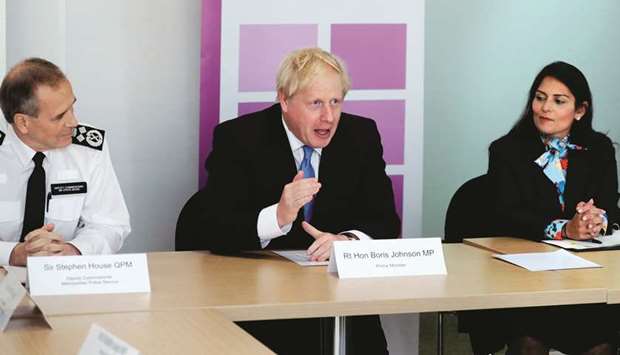
Prime Minister Boris Johnson, accompanied by Home Secretary Priti Patel speaks at the first meeting of the National Policing Board at the Home Office in London yesterday.